
Journal ·
Black Peppercorn
In English property law a peppercorn rent means a nominal sum, essentially nothing. That phrase exists because pepper was once money.
The Word For Almost Nothing
Season 1 · Episode 14
There's a phrase in English property law: a peppercorn rent.
It means a nominal sum. A lease held for one peppercorn a year is a lease held for essentially nothing, a legal fiction to make a contract binding without anybody actually paying.
The phrase is old enough that most lawyers using it have forgotten it was ever literal. But it was. Medieval European documents record rents, taxes and dowries settled in pounds of pepper, and the phrase survives because collecting a peppercorn was once worth the trouble.
Pepper is the only spice to have completed the full arc from treasure to condiment. The language fossilised both ends of it.
The vine
Piper nigrum is a climbing vine native to the Malabar Coast of southwestern India, in what is now Kerala. It climbs by aerial roots and will reach ten metres or more given a tree or a pole. The leaves are broad and glossy. The fruit starts green and turns red as it ripens.
Black, white and green pepper are all the same plant. What separates them is when the fruit is picked and what's done to it afterwards.
Pink peppercorn is not. It comes from Schinus species, mostly the Brazilian and Peruvian pepper trees, in a different family entirely. It's in the grinder for the colour.
There's an older confusion underneath that one. Long pepper, Piper longum, is a close relative that was once the more prized of the two in Europe, and for centuries "pepper" in Mediterranean trade could mean either. The record frequently doesn't say which.
The name arrived already old
The English pepper descends from Latin piper, which comes from Greek peperi, which is generally agreed to be a borrowing from an Indic language, most likely something ancestral to Sanskrit pippali.
The word travelled with the cargo. It's one of a small number of plant names that moved west along the spice routes and reached Europe already worn smooth by the journey.
Rome complained about the bill
Roman merchants were sailing to India for pepper by the first century CE, and the trade was large enough to worry people. Pliny the Elder grumbled that pepper was bought with gold and silver and that the empire's coin was draining east to India and China.
The complaint is itself the evidence. You don't write that sentence about a trade that isn't substantial.
Being careful here. The figure usually attached to this, that Rome spent around ten million sesterces a year on pepper, is widely repeated and attributed to Pliny, and we could not source the passage. So it stays out.
The route ran from the Malabar ports up the Red Sea, overland to the Nile, downriver to Alexandria, and across the Mediterranean from there. Arab and Indian merchants held the sea legs.
Money, not metaphor
By the medieval period pepper was the benchmark spice of European commerce, and it functioned as stored value as much as flavour. It appears in guild records and household accounts. Rents, dowries and taxes were settled in it.
That's the part worth sitting with. A sack of dried berries was a way of holding wealth, because it was compact, durable, universally wanted, and could not be manufactured in Europe at any price.
The search that redrew the map
Venice and Genoa grew rich on the eastern Mediterranean leg of the pepper trade in the late Middle Ages. That Venetian monopoly was the direct economic motive behind the Portuguese push around Africa.
When Vasco da Gama reached Calicut in 1498, the stated objective was Christians and spices, and in the mind of the Portuguese crown the two were not separable.
The Portuguese held much of the sea trade for roughly a century from fortified posts along the Malabar Coast. The Dutch displaced them in the seventeenth century and took the pepper ports. The British displaced the Dutch across the Indian Ocean in the eighteenth and nineteenth.
Three empires, one vine.
Why it stopped being money
Because the sea route matured and the supply rose, and a thing that is abundant cannot store value.
We looked for a price series to put numbers on that and couldn't source one we trusted, so there isn't one here. The direction is not in doubt: pepper fell from a luxury of the wealthy to a thing on every table, and the word for it became the legal term for almost nothing.
What's actually in it
Piperine, which is what makes pepper hot, and which has one genuinely interesting modern property.
Piperine changes how the body handles other substances. It can increase the bioavailability of co-administered drugs, and for drugs with a narrow therapeutic index that's a real hazard rather than a benefit.
We met this three episodes ago from the other side. Turmeric trials add piperine precisely because curcumin is so poorly absorbed without it, and that was a defined extract at a defined dose.
Which sets up the same gap the licorice episode turned on. A standardised piperine extract in a capsule is not ground pepper on your dinner. The dose, the preparation and the intent are all different, and the evidence does not walk across that gap just because the compound has the same name.
Anyone on medication where the dose is finely judged should raise concentrated piperine supplements with a clinician. Pepper on food is food.
In the blend
Black peppercorn is three quarters of one part in sixteen and a half.
It's the heat at the back, the thing you notice after you've swallowed rather than while you're drinking. At that share it sharpens the edges of everything else without announcing itself.
What we're claiming
Nothing, medically. This is history.
What's fair to say is stranger than a health claim. The vine that drained Roman silver east, that was hoarded as treasure, that sent Portuguese ships around a continent and cost three empires a century of fighting each other, now sits in a shaker on a diner table next to the salt, free with the meal.
And its name is the word lawyers use when they mean nothing at all.
Further reading
Sources consulted for this article and its episode are listed at the bottom of the page.
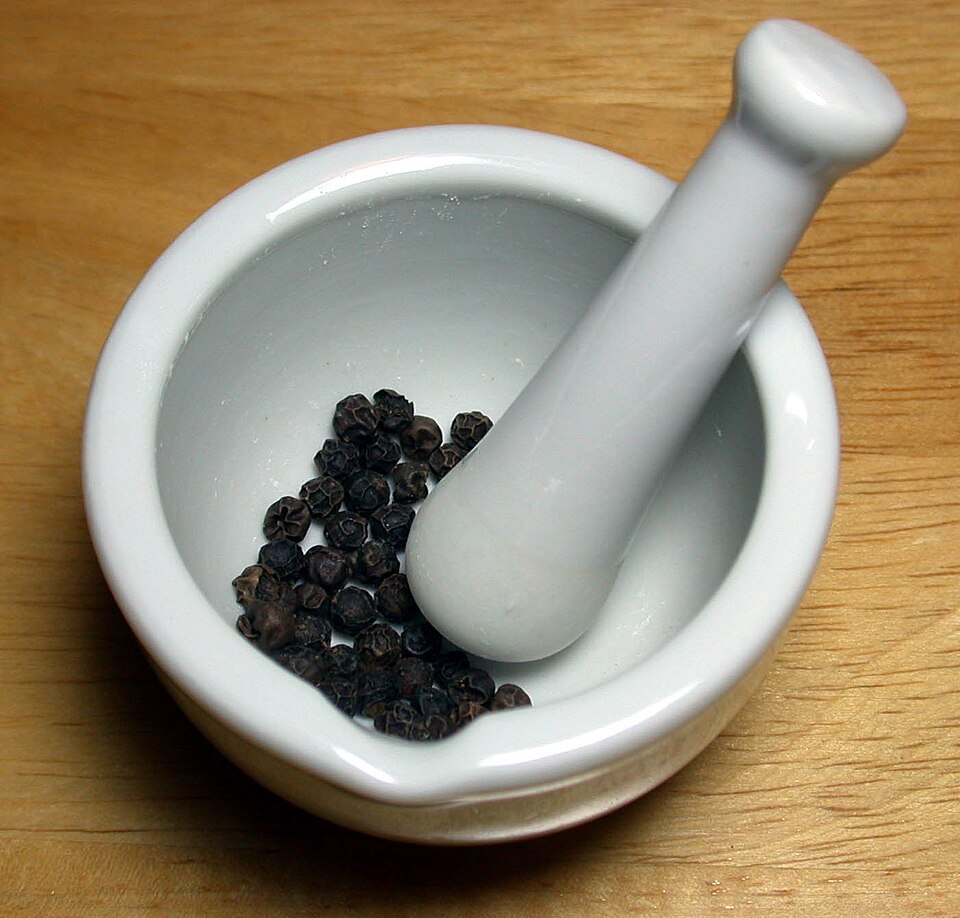
Photograph: Dvortygirl, CC BY-SA 3.0, via Wikimedia Commons