

Journal ·
The Tree You Had To Ask
Across Denmark, Germany and England, folk custom held that you greeted the elder and begged leave before cutting it. Those manners turn out to be a safety technology.
The Tree You Had To Ask
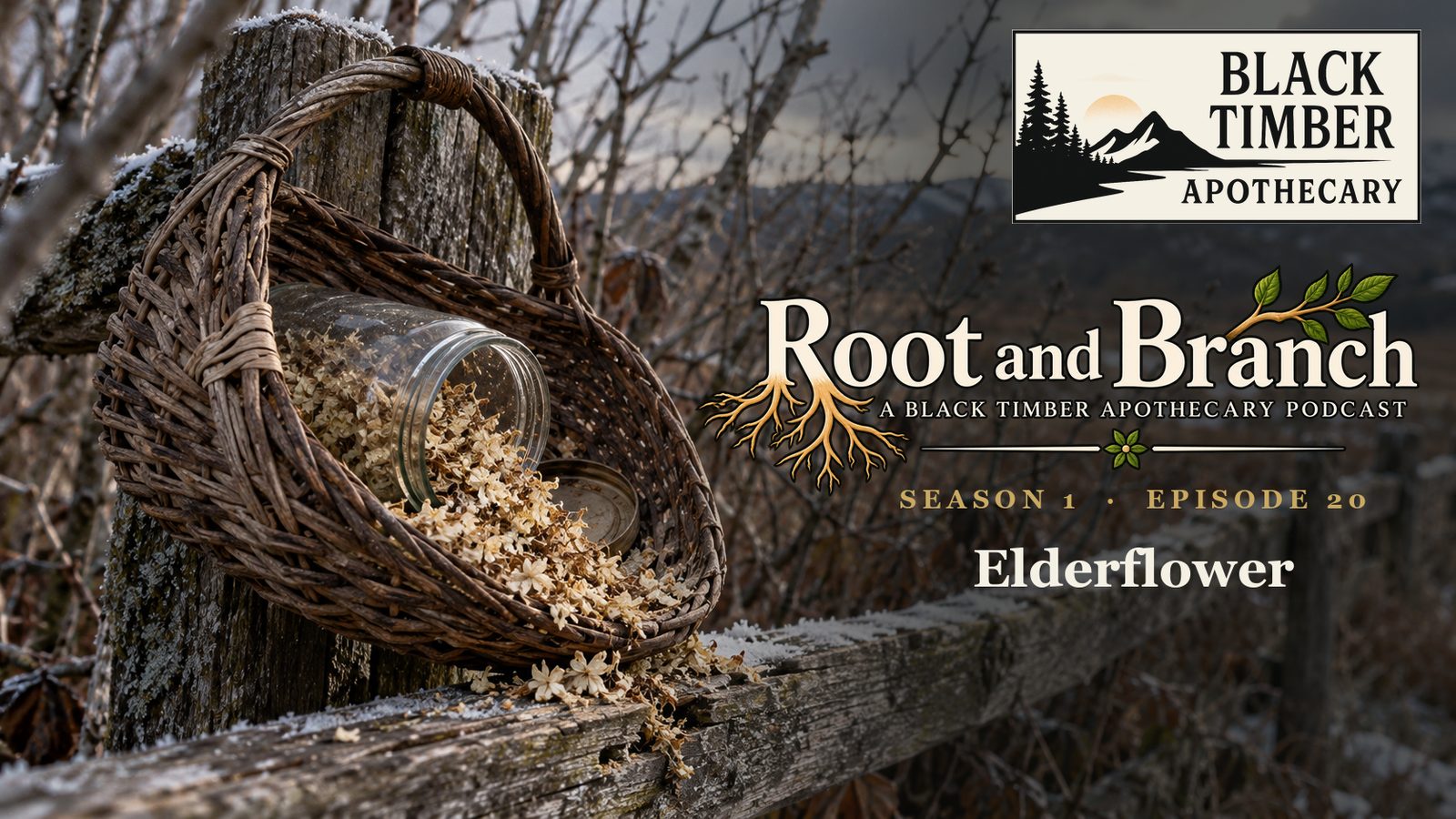
Season 1 · Episode 20
There is a tree in the European hedgerow you were supposed to ask.
Across Denmark, Germany and England, folk custom held that an elder was inhabited. The Danish name for the resident was hyldemoer, the Elder Mother; German dialect has Holunderfrau, and parts of England kept a formula addressed to a Lady Ellhorn. Before you cut a stick from an elder, you greeted her and you begged leave.
A rhyme went with the asking. It survives in several wordings and we could not source an authoritative edition of any of them, so we are not going to quote one. The shape of it is a trade: take some of my wood, and I will give you some of mine when I am a tree.
Hold onto those manners. They look like superstition and they end up being something closer to an instruction manual.
The parts are not one plant
Sambucus nigra, the European elder, is a shrub or small tree of the Adoxaceae, once filed under Caprifoliaceae. The flower is a flat-topped corymb of cream-white, five-petalled florets a few millimetres across, opening late May into June.
Here is the turn the folklore never makes. The parts of this plant do not behave alike. Leaf, bark, root and unripe berry carry cyanogenic glycosides, chiefly sambunigrin. The flower carries them at low level, well below the vegetative parts, and it is the low-risk part of the plant.
We could not source a quantitative figure for sambunigrin in dried S. nigra flower, so there isn't one here. The direction is well supported; the margin we cannot state.
Name the species, too. Red elder, S. racemosa, has rounded conical clusters rather than flat-topped ones. Dwarf elder, S. ebulus, is toxic and grows in similar ground. The real hazard in foraging elder is not the flower. It is picking the wrong plant.
The name may remember fire
English elder descends from Old English ellærn or eldrun, and the word is entangled with a root meaning fire, likely because the hollow stems were used to blow air into kindling. A plant named for what you could do with its dead wood.
Nigra is for the berries, which are near-black. It is not a description of the flower at all.
The printed record picks the plant up in the herbals. William Turner's A New Herball began appearing in parts from 1551. John Gerard's Herball followed in 1597. Nicholas Culpeper's Complete Herbal of 1653 assigns elder to Venus, which tells you about the astrological medicine of the period rather than about the plant.
We are not quoting any of them. No edition could be sourced, and a quotation from a herbal is either exact or it is invention.
The flower's own legend is thin
English and German tradition made the elder the tree Judas hanged himself from. It is a floating legend, told of the aspen and the fig as well, and elder is a pithy, weak-wooded little tree that would not bear a man's weight. That argues the story is symbolic rather than literal: the tree that betrays, standing at the edge of the yard. No origin text for the Judas strand could be sourced, and we say so rather than supply one.
The rest of the lore runs the same ambivalent way. Elder was unlucky brought indoors, unlucky in a cradle, unwise to stand under at dusk, and planted by the door as a guard. A boundary plant is protective and dangerous at once, which is not a contradiction so much as a job description.
Now the reversal. Nearly all of that attaches to the tree, the wood, the bark, the berries. The flower's share of the mythic record is thin. We looked for a body of legend belonging to the flower as distinct from the plant and did not find one in the sources we examined. That is a statement about our search, not about the world, and the gap is the honest finding.
What the flower has instead is a calendar.
What is inside it
Rutin leads: quercetin-3-O-rutinoside, the compound usually used as the standardisation marker. With it come isoquercitrin, astragalin, chlorogenic and caffeic acids, the triterpenes ursolic and oleanolic acid, and mucilage.
The volatile oil is tiny. Cis-rose oxide carries much of that muscat note, which is why a product advertising a large essential oil fraction is not a plain flower.
Then the gap. The substantial Sambucus trial literature is the berry, and it does not transfer: the berry is anthocyanin-rich and chemically a different extract. For the flower alone, no controlled trial with a defined primary outcome could be sourced. What exists in reach is cell-culture work. A mechanism is not an outcome, and cell-culture concentrations are not what a cup of tea puts in your blood.
Black peppercorn, six episodes back, gave us this gap from the other side: a defined extract at a defined dose is not the thing on your dinner. Here it runs the same way. A standardised extract states a marker content per dose. A cup of blended tea is a gram or two of dried flower, variable with the harvest, the drying, the water and the steep. A finding about one does not cross to the other, in either direction.
Timing is the whole craft
Pick the umbels fully open. Past peak they go musty, almost catty, and that note carries straight into a syrup. Green buds are just bitter.
Cut above the branch of the head. Strip the florets off the green stems, which is the same distinction the plant has been making all along. Dry in shade, in thin layers, with airflow; sun drives off the volatiles that are the entire point. Dry until crisp, store airtight and dark, use it inside a season. Browning is oxidation.
To brew: a heaped teaspoon per cup, water just off the boil, covered, five to ten minutes. Cover it. The aromatics leave with the steam.
Cool and dry, moving upward and outward
One line holds the old reading of this flower: cool and dry, moving upward and outward. It opens the surface rather than working deep.
Folk tradition held it a diaphoretic, the historical word for promoting perspiration, taken at the first chill, usually with peppermint and yarrow or with linden. That is a record of what was done, not evidence that it worked.
There is a craft point buried in that formula. Equal parts of three cooling diaphoretics is a stacking error, not a strong blend. Three herbs pulling the same direction at the same weight gives you no lead and no counterweight.
Cautions at their true size: loose stool at concentrated doses; precaution in pregnancy, which is precaution and not a documented harm signal; and no documented interaction specific to S. nigra flower could be sourced. Theoretical is not documented, and we are not going to dress one as the other.
Six weeks, and then it's gone
The elder flowers for roughly six weeks at the turn of May. A country saying ran that summer is not come until the elder is out. We are paraphrasing; the wording is unsourced.
What happens in that window is the flower's real tradition: cordial, fritters with the whole head dipped in batter and the stem left on as a handle, the fermented champagne, Danish hyldeblomstsaft, gooseberry and elderflower in a fool. The branded liqueur era is recent industry laid over old domestic practice, and we have no date for the first commercial cordial.
Now the manners pay off. Ask, so you look at the tree and know what it is. Flower only, not bark or leaf or green stem. Infuse or cook it; don't eat the green parts raw. Every rule the folklore enforced with a guardian spirit is a rule that keeps the dangerous parts of an ambivalent plant out of the cup. The taboo was the technology.
In the blend
Elderflower is a small share of the sixteen and a half parts of Buckshot & Gunpowder, and it should be.
It is the top note. Floral, muscat, honeyed, the lift you meet before anything else arrives. Elderflower is a poor lead: given the whole of a flavour it turns soapy and cloying. At a supporting fraction it perfumes everything around it and never announces itself.
What we're claiming
Nothing, medically. A flavour and a history.
The history is good enough on its own. A hedgerow tree people would not cut without speaking to it first, whose wood blew air into their fires and whose flowers mark the week summer starts, and whose etiquette, read closely, is a set of handling instructions for a plant that is not one plant.
Further reading
Sources consulted for this article and its episode are listed at the bottom of the page.