Journal ·
The Story That Was Too Good
The witches of Salem were really poisoned rye. It is a satisfying ending, and this episode is about why a satisfying ending is not the same thing as a sourced one.
The Story That Was Too Good, Ergot and Salem
Season 1 · Episode 18
This is the one episode of Root & Branch with no plant in it.
It is also the one where we set out to tell a famous story and then decline to deliver its ending. The story goes: the afflicted girls of Salem Village in 1692 were not bewitched, and nobody was lying. They had eaten bread made from rye infected with a fungus, and the fungus made them convulse and hallucinate, and twenty people died on the strength of a bad harvest.
It is a very good story. It is clean, it is secular, it is teachable, and it turns a theological catastrophe into a problem of agriculture. It has appeared in classrooms and museum copy and popular history for decades, usually without the qualifications its author attached to it.
We are not going to tell you it is true, because we cannot. We are going to tell you something more useful: how a published hypothesis becomes common knowledge without ever earning it, and how to spot the difference from the outside.
Not an herb, a fungus
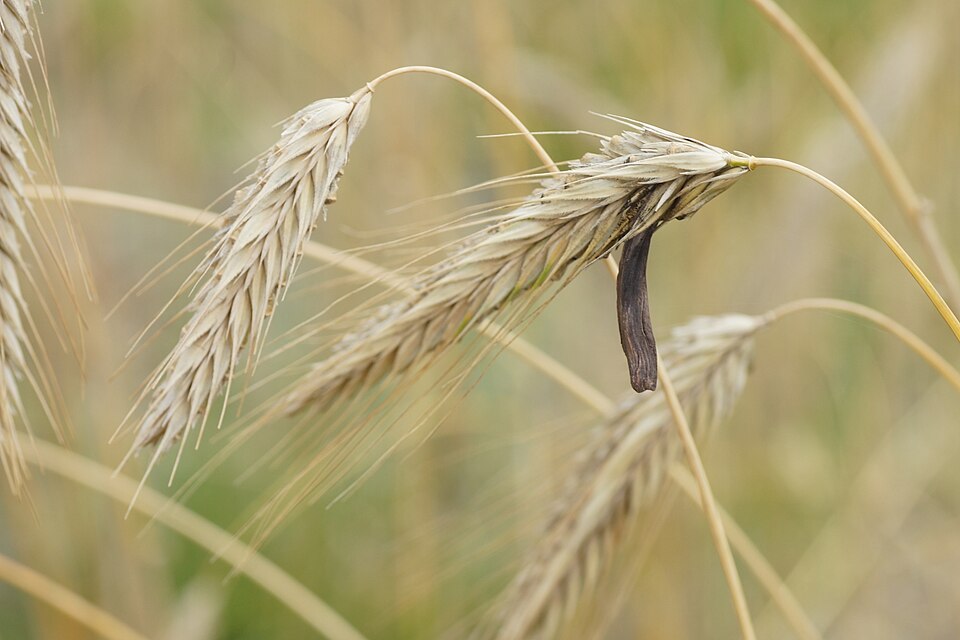
Claviceps purpurea infects the flowering ovary of rye, Secale cereale, and other cereals. Where the grain should form, the fungus grows a hard dark spur in its place: a sclerotium, which is the thing called ergot.
One point of precision before anything else, because the whole episode depends on it. "Ergot" is not a species. C. africana infects sorghum. C. fusiformis infects pearl millet. C. paspali infects Paspalum grasses. Each is a different organism with its own alkaloid profile, and a finding about sorghum ergot is not a finding about rye ergot. Only C. purpurea belongs in a New England account, and we hold that line in both directions.
Farming put it in the bread
Ergot did not get into European bread by accident of wild nature. It got there because of how people grew grain.
The fungus wants a cool wet spring at flowering. Rain splashes its conidia onto open florets, so a wet season at exactly the wrong week is the whole mechanism. Rye was the most susceptible of the common bread grains, and rye was the grain of poorer households on thin soil. The spur overwinters, including in saved seed, so a bad year tends to be followed by another bad year unless somebody cleans the seed.
Then comes the step that matters most, and it runs the wrong way from intuition. Milling concentrates it. The sclerotium is brittle, and it grinds into a fine dark powder that distributes itself evenly through the flour. Nothing in stone milling takes it out. A field problem becomes a household exposure at the mill.
St. Anthony's fire
Historical ergotism is described in two pictures. The gangrenous form is sustained vasoconstriction severe enough to produce dry gangrene of the extremities. The convulsive form is spasms, convulsions, and in some accounts hallucinations. Both are serious, both are documented in European history, and neither is a mild botanical curiosity.
Two pieces of received lore attach to the name, and we flag both rather than repeating them as fact. The name "St. Anthony's fire" is said to come from the Order of St. Anthony, whose hospitals cared for sufferers of the gangrenous form. "Ergot" is said to be French for a rooster's spur, after the shape. Both are widely repeated. Neither could be traced to a primary source for this episode, so both stay in the file as received rather than verified.
A mixture, not a substance
C. purpurea sclerotia do not carry one compound. They carry a mixture: ergometrine (also called ergonovine), ergotamine, ergocristine, ergocryptine, ergocornine, in proportions that vary with the fungal strain, the host plant, the season and the storage.
They are not interchangeable. Ergometrine is relatively more oxytocic. Ergotamine is a strong vasoconstrictor. These compounds act on adrenergic and serotonergic receptors, and that is the mechanistic basis for the vasoconstriction.
Now the sentence this episode exists for. A mechanism is not an outcome. Receptor activity explains why extremities go cold and tissue dies. It does not deliver one specific hallucination to one specific girl in one specific room in 1692. The gap between "this compound binds that receptor" and "therefore that testimony" is enormous, and the popular version of the Salem story crosses it in a single sentence.
The dose problem
Sclerotia float in brine and sound grain sinks, so sorting was physically possible. Whether Essex County farmers did it in the 1690s could not be sourced for this episode, and we are not going to guess.
Alkaloid content degrades with heat, light and time, and is more stable in the whole spur than in milled flour. A winter's stored flour is weaker in March than it was in October.
Put it together and you get the thing no retelling of the story can get past. A contaminated loaf is an unstandardised mixture of several different alkaloids, at an unknown concentration, eaten over an unknown period, by people of unknown weight and nutritional state. A measured pharmaceutical dose of a named alkaloid is a different object entirely. No conversion factor runs between them, in either direction, and the absence of one is not a technicality. It is the reason the Salem claim cannot be checked.
The hypothesis at its true size
Linnda Caporael published "Ergotism: The Satan Loosed in Salem?" in Science 192 in 1976. Her argument had four legs: rye was a staple, the season was favourable to the fungus, the recorded symptoms resembled convulsive ergotism, and the accusations clustered geographically.
The rebuttal arrived in the same journal the same year. Nicholas Spanos and Jack Gottlieb, in Science 194, 1976, argued that accused and accusers drew from the same grain, that the accused showed no symptoms, and that the fits appeared in court and stopped outside it. That last point is the hardest one for the hypothesis to absorb, because a fungus does not know where the courtroom door is.
There is also a reading that does not need a fungus at all. Paul Boyer and Stephen Nissenbaum's Salem Possessed (1974) read the accusations as faction and property, a village tearing along lines it already had.
What could not be sourced
Said out loud, because this is the part that decides the question.
No surviving Salem grain or flour has been analysed for alkaloids. No mill or tax record establishing the village's rye consumption could be sourced for this episode. No verified reanalysis of the accusation map against reconstructed land use could be sourced either. These are gaps in what we could reach, not proof that nothing exists.
Which leaves the honest verdict in an uncomfortable place: not established, and not refuted. The evidence that would settle it is gone.
And there is a specific failure to name, because it is the transferable lesson. Caporael is cited. Then Mary Matossian's Poisons of the Past is cited. Then retellings cite both, and later retellings cite those retellings, and the pile gets read as corroboration. It is not. Count evidentiary bases, not citations. On this question the bases are thin and the citations are many, which is exactly the shape of a story that became a fact by being repeated.
In the blend
Nothing from this episode is in the tin. There is no ergot in Buckshot & Gunpowder and no fungus of any kind. This one was history.
What is in it: a sixteen-and-a-half-part black tea, hand-blended in small batches by a family in the Bozeman valley, Montana. Smoke and heat, the cup you want on a cold morning. You can buy it at blacktimberapothecary.com.
What we're claiming
Nothing, medically, and nothing historically either. We are not telling you ergot caused Salem and we are not telling you it did not.
What we are claiming is a habit. When a story is this satisfying, that is the moment to ask what sits under it, and to count the independent bases rather than the footnotes. The Salem ergot hypothesis is a real proposal, published in a real journal, contested in the same journal, and never settled. It became common knowledge anyway, because the ending was too good to check.
Thanks for listening to Root & Branch. Come back next time.
Further reading
Sources consulted for this article and its episode are listed at the bottom of the page.
Photograph: Kasper Malmberg