
Journal ·
Fenugreek Seed
A seed that smells of maple syrup, a name that means Greek hay, and a citation everybody repeats from a book that does not contain it.
Greek Hay and the Maple Syrup Mistake
Season 1 · Episode 3
In 1999 the New England Journal of Medicine published a short case report about a baby who did not have the disease he appeared to have.
The infant's urine smelled of maple syrup. That is not a figure of speech in medicine. It is the defining sign of maple syrup urine disease, an inherited metabolic disorder that takes its name from exactly that symptom and which, untreated, is dangerous. The diagnosis was made. It was wrong.
The mother had been drinking fenugreek tea. Fenugreek contains sotolon, the aroma compound that gives maple syrup its smell, and sotolon passes out of the body in sweat, urine and breast milk. A seed in a herbal tea had imitated a genetic disorder convincingly enough to alarm a hospital. Sewell, Mosandl and Bohles wrote it up, and it remains the tidiest illustration of the one thing fenugreek does more reliably than anything else it is sold for.
Greek hay
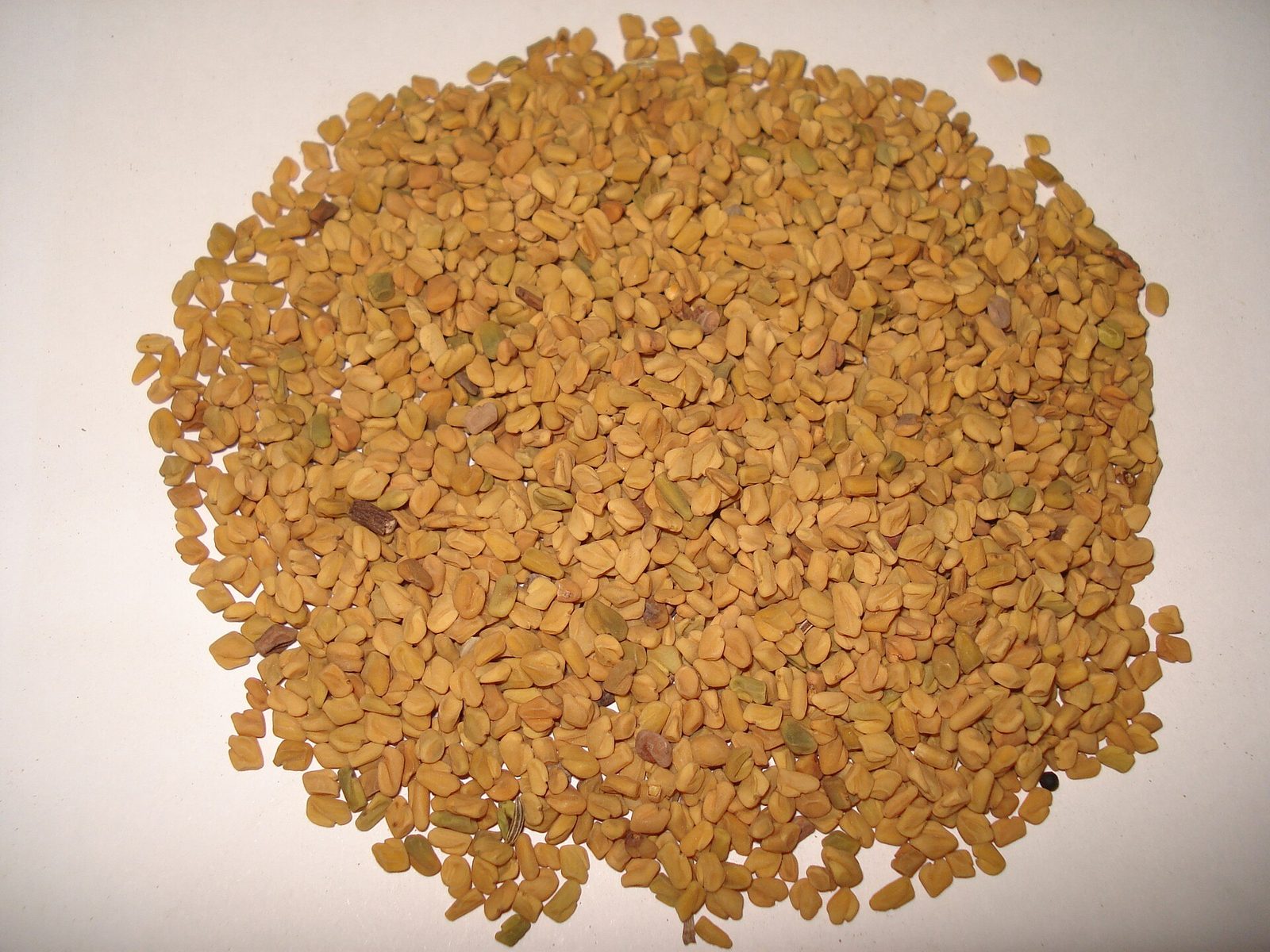
The seed is small, hard, angular and ochre. Bite one raw and it is bitter in a way that does not invite a second.
Its botanical name is Trigonella foenum-graecum, and it translates almost comically plainly. Foenum is Latin for hay. Graecum means Greek. Trigonella comes from the Greek for three-angled and describes the shape of the flower and the pod. Greek hay, three-cornered.
The name is a fossil of the plant's first documented job in Europe, and the job was not medicine. Cato the Elder, writing in the second century BCE, described fenugreek as a crop grown to feed cattle. The German name preserves it too: bockshornklee, buck's horn clover. It is a legume, in the pea family, and like other legumes it fixes nitrogen in the soil, which is why farmers have kept it in rotation for thousands of years. Before it was ever a spice it was fodder and a soil improver.
The record is enormous, which is the problem
Rooibos has almost no documented past, and the honest story there is the gap. Fenugreek is the opposite. The record runs back four thousand years and further, and the danger is not absence but credulity.
The earliest firm evidence is the Ebers Papyrus, dated to about 1550 BCE, the most important surviving Egyptian medical text and a collection of roughly seven hundred prescriptions. Fenugreek is named in it. That is a documentary record of medical use, and it is solid.
The archaeology is older and shakier, and deserves to be described as such. The most cited find is from Tell Halal in the Tigris-Euphrates region of modern Iraq, dated to roughly 4000 BCE. It is genuine and it is important, and both the dating and the identification of the seeds have been questioned. Seeds have also been reported from the tomb of Tutankhamun and from Harappan sites in the Indus Valley around 2000 BCE, which is why fenugreek turns up so early and so deeply in Indian cooking.
Then the classical writers, and these are firm. Dioscorides covered it in De materia medica, written between 50 and 70 CE, a five-volume pharmacopoeia that stayed the principal reference on pharmacology across Europe and the Middle East for over fifteen hundred years. It was never lost and never rediscovered; it was copied continuously in Greek, Latin and Arabic. Pliny the Elder wrote about it too.
The citation nobody checked
Search for fenugreek and you will find Nicholas Culpeper quoted as an authority on it. Culpeper is a satisfying source to cite. He is vivid, he is out of copyright, and he wrote about everything.
He did not write about fenugreek.
The Complete Herbal of 1653 is a British flora, and Culpeper says so in his epistle to the reader: "I write not of exoticks." Fenugreek is not a British plant and has no entry in his herbal. He mentions it exactly once, buried inside his entry on Marshmallow, where he notes that "the mucilage of the roots, and of Linseed and Fenugreek put together, is much used in poultices."
That is the whole of it. A passing clause in an entry about a different plant, which has become "Culpeper on fenugreek" through nothing but repetition.
The same holds for the other British herbals people reach for. Fernie's Herbal Simples of 1897 and Phelps Brown's Complete Herbalist of 1878 are also British in scope. The books that genuinely document this plant are the ones with wider reach: Dymock's Vegetable Materia Medica of Western India of 1885, which records the Indian methi, and Stuart's Chinese Materia Medica of 1911, which records the Chinese hu lu ba.
Two great traditions, an ocean apart, both using the same seed and framing it differently. Neither of them is Culpeper.
The embalming story fails the same test. Countless articles say fenugreek was used in Egyptian embalming. The plant was certainly in Egypt and it is in the Ebers Papyrus, but no unambiguous archaeological find puts it in an embalming context. It is repeated everywhere and sourced nowhere.
What it actually does
Sotolon again, because it is the honest headline. It is why the seed smells of maple, why fenugreek is used commercially as a maple flavouring, and why it turns up in sweat and urine. The LactMed database puts it without ceremony: "perhaps its most unusual side effect is the imparting an odor of maple syrup to the urine, sweat, feces, and possibly breastmilk."
The two claims the seed is actually sold on are weaker than the marketing suggests, and they are weak in different ways.
On milk supply, the traditional use is real and old. The modern evidence is not good. LactMed notes the effect "may be primarily psychological in humans." One meta-analysis found a mild effect, another found no good evidence, and the better-designed studies tend to show none.
On blood sugar, there is more to work with. The most cited meta-analysis, Neelakantan and colleagues in 2014, pooled ten trials and found reductions in fasting glucose and HbA1c. The National Center for Complementary and Integrative Health is blunt about what those trials were worth: "many of the studies were not of high quality." No regulator has approved a diabetes claim for it.
There is also a caution that belongs here rather than in small print. The NCCIH states that fenugreek is not safe in pregnancy in amounts greater than those found in food, and that its use has been linked to increased risks of birth defects in animals and in people. The European Medicines Agency monograph says animal studies have shown reproductive toxicity and that use in pregnancy and lactation is not recommended. That is what those bodies say, and it is worth knowing before anyone drinks it by the potful.
In the kitchen, which is where it earns its keep
India is the heart of the fenugreek world, the largest producer and the largest consumer, and Indian cooking is where the seed makes most sense.
The raw seed is hard and bitter. Heat and grinding transform it entirely, which is why the same seed reads as harsh in one dish and sweet in another. It is fried whole in oil to open it up, ground to a powder, sold as dried leaves called kasuri methi, eaten sprouted, and grown as a leafy green. The European Medicines Agency lists two traditional-use indications for it, both modest: temporary loss of appetite, and minor digestive complaints.
In our blend it sits behind the rooibos, bringing that faintly sweet, nutty, maple-adjacent note. A little carries a long way, and more than a little takes over.
The thing worth keeping
Very few plants have been genuinely useful in three separate roles for this long. Fenugreek fed cattle, which is what its name still remembers. It fed people, and became a staple at the centre of the world's largest vegetarian cuisine. And it was a medicine in two traditions that never spoke to one another.
Four thousand years of that, and the effect it produces most reliably is still the one nobody sells: it makes people smell like breakfast.
Further reading
Sources consulted for this article and its episode.
- en.wikipedia.org — De materia medica - feedipedia.org - ncbi.nlm.nih.gov — NBK501779 - nccih.nih.gov — fenugreek
Photograph: Miansari66, public domain, via Wikimedia Commons