

Journal ·
Ginger Root
There is no wild ginger anywhere on earth. Every plant alive is a cutting of a human decision, and the species has no ancestor anyone can name.
The Plant With No Wild Home
Season 1 · Episode 7
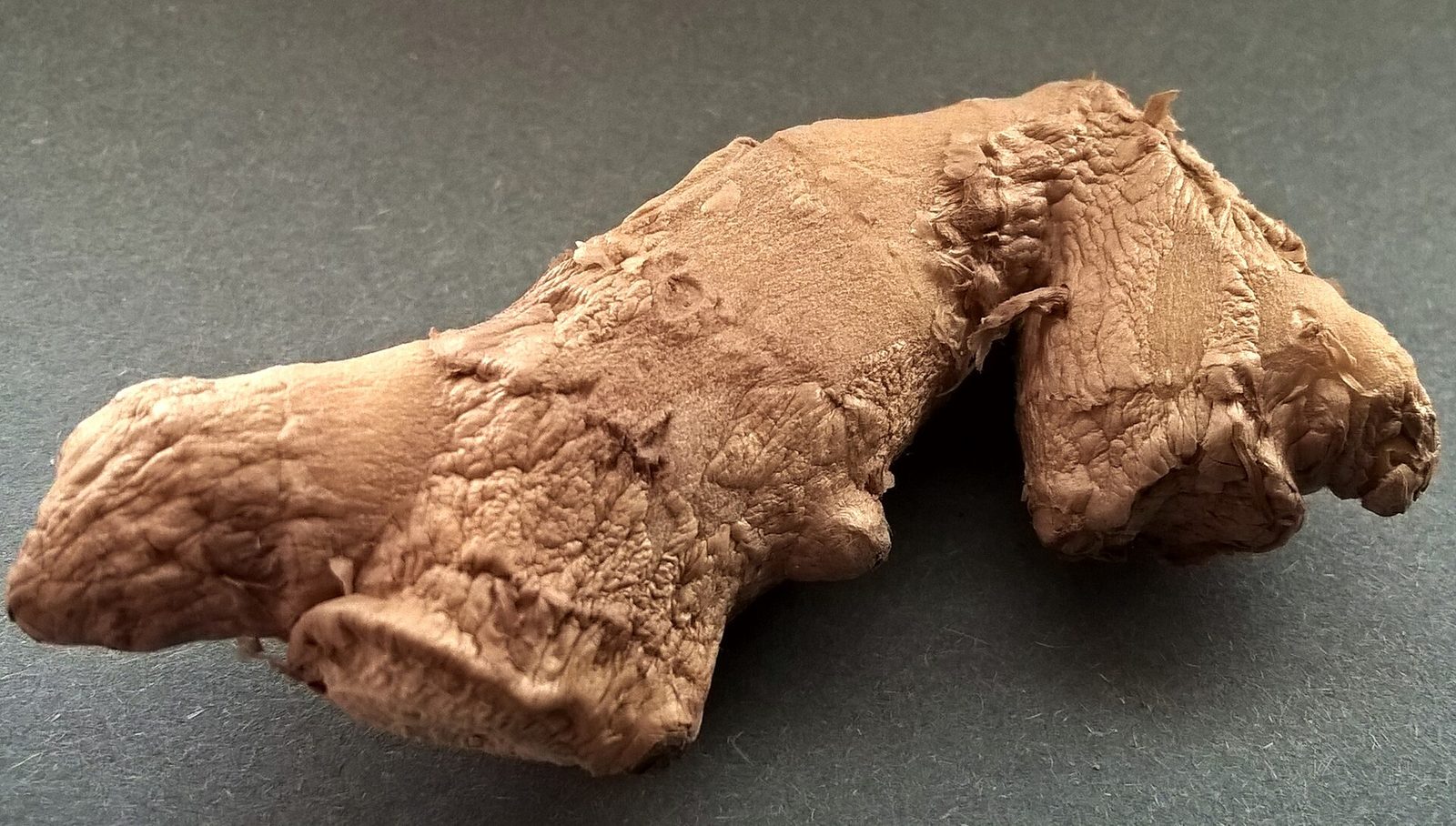
Pick up a piece of ginger and look for the buds. They're there: small pale points on the knuckles, sometimes already pushing a green shoot. That's the tell. Roots don't have buds. Stems do.
Ginger is a rhizome, an underground stem, the same kind of structure as a potato. It has nodes, scale leaves and growing points, and it's planted by cutting it into pieces that each carry at least one bud. Everyone in the trade calls it ginger root, including us, because that's what's on the label and what a buyer types into a search box. The botany is settled anyway, and it's worth saying once.
It matters here more than it would for most plants, because how ginger reproduces is the strangest thing about it.
There is no wild ginger
Zingiber officinale has no known wild population. Not rare, not endangered, not restricted to some inaccessible valley. There's nowhere on earth you can go and find ginger growing without someone having put it there.
The plant is a sterile polyploid, and the literature can't even agree on the chromosome count: 2n = 22 and 2n = 44 are both reported depending on which accession was studied. That disagreement is itself a symptom. A sterile cultivated plant with no wild reference population is exactly the kind of organism whose cytology gets muddled.
Because it's sterile it sets no viable seed, so it's propagated only by dividing the rhizome. Every ginger plant alive is a clone, or a clone of a clone, descended from divisions made by human hands and kept going for millennia. There's no wild reservoir to go back to and no seed bank of natural variation to draw on.
The wild ancestor is genuinely unresolved. Zingiber zerumbet, the bitter or shampoo ginger of South and Southeast Asia, is among the species proposed as a close relative or possible ancestor, but the relationship isn't settled and the literature shows disagreement rather than consensus. The honest statement is that ginger is a cultivated plant of uncertain wild origin, with several candidates and no accepted identification.
Peppermint has the same structure to its story, and both plants end up in this blend. A sterile hybrid found once and carried by hand ever since. Ginger's version is older and the trail is colder.
It travelled because people carried it
A plant that can't set seed can't spread on its own, so ginger's distribution is a map of human trade rather than of climate.
Its centre of origin is generally placed in maritime Southeast Asia, around the Malay Archipelago and the Indonesian islands, where the Zingiber genus is most diverse. From there it reached India early and was absorbed into culinary and medical practice. It reached China, where it became one of the more important entries in the materia medica, and where a distinction was drawn that turns out to be chemically real: fresh ginger, sheng jiang, and dried ginger, gan jiang, are treated as two related but different drugs.
By the Roman period it had reached the Mediterranean as an import, moving from India and Southeast Asia through the Red Sea to Alexandria and Rome. That's the key to reading the classical sources correctly. The authors describing ginger are describing something that arrived by ship.
Dioscorides describes it specifically, in De Materia Medica II.160, as an imported warming rhizome. Pliny mentions it more loosely among imported roots and is confused about where it comes from. They're routinely cited together as though they said the same thing, and they didn't.
Culpeper has no entry for it
The Complete Herbal of 1653 contains no ginger entry. A full-text search of the Project Gutenberg edition finds ginger only inside compound recipes and in his "Explanation of certain Vacuations" lists, never with its own "Government and virtues" section.
The reason is the same one that keeps fenugreek out of the book. Culpeper wrote about the herbs of the English field and hedgerow, and ginger is an import. Anyone quoting "Culpeper on ginger" as though he gave it a treatment is quoting something that isn't in the book.
The sheep is real, and smaller than it sounds
The best-known ginger fact is that a pound of it cost as much as a sheep in medieval England.
This one isn't invented. It traces to English assize and price records of the 1285 to 1290s, where a pound of ginger is cited at roughly the value of a sheep. What's wrong is how it's repeated. The comparison is tied to particular years and particular markets, and articles that state it as a general truth about "medieval England" stretch it past what the records support.
It's worth being clear about the limit of our own checking here as well: the underlying assize records weren't read directly for this article, only the secondary summaries that cite them. A real fact, inflated into a bigger one, and the inflation is the part that travels.
Drying makes it hotter
The pungency of fresh ginger comes from gingerols, chiefly 6-gingerol. Drying drives a dehydration reaction that converts gingerols to shogaols, so 6-gingerol becomes 6-shogaol and the same conversion runs across the group.
Shogaols are more pungent by weight, and the heat has a different quality: sharper, more lingering, less bright than the fresh rhizome. That's why dried ginger tastes hotter than fresh in the same quantity, and it's the chemical basis for the distinction Chinese practice drew centuries before anyone could name the compounds.
Something is lost as well. The aromatic fraction, dominated by zingiberene and related sesquiterpenes, carries the citrus-and-pine top note of fresh ginger, and drying partly destroys or alters it. Dried ginger is more about heat than about aroma.
For a blend, the practical consequence is timing. The gingerols and shogaols are only moderately water-soluble and need heat and time, while the volatiles come out fast. Steeped at green-tea temperatures, dried cut ginger is a slow contributor: aroma and a mild warmth early, the fuller pungency later. One part of it against four parts of gunpowder green tea has to work against an assertive, astringent, smoky base, and it releases over the length of the infusion rather than all at once.
What the trials actually used
Ginger has the strongest clinical evidence of any herb in this blend, which creates the opposite temptation from the usual one. The risk here isn't propping up a weak claim. It's overstating a real result.
Nausea and vomiting of pregnancy is the strongest indication. The central reference is Viljoen, Visser, Koen and Musekiwa, "A systematic review and meta-analysis of the effect and safety of ginger in the treatment of pregnancy-associated nausea and vomiting," in Nutrition Journal 13:20, published 19 March 2014. Postoperative nausea is supported by a smaller and dose-dependent effect, in Chaiyakunapruk and colleagues in the American Journal of Obstetrics and Gynecology in January 2006. Motion sickness results are mixed. For chemotherapy-induced nausea they're genuinely mixed, and guideline bodies don't endorse ginger as a standalone.
Then the number that governs everything above. Those trials used standardised dried rhizome powder, commonly 1 to 2 g per day, in capsules. A single part of dried cut ginger in a sixteen-and-a-half-part blend, steeped for a few minutes in water that doesn't fully extract the pungent compounds, delivers a small fraction of that.
The blend is a beverage with ginger in it. It isn't a delivery system for a studied dose, and it shouldn't be sold as one. Beyond nausea, where ginger is marketed for inflammation, joints, cholesterol and blood sugar, the human trials are small and inconsistent and the article says so.
As a caution rather than advice: ginger shows antiplatelet activity in laboratory work, and whether that matters at dietary doses isn't established, which is a reason to raise it with a clinician rather than to assume it's inert.
The plant has been kept alive by hand for several thousand years without ever producing a viable seed.
Further reading
Sources consulted for this article and its episode.
- en.wikipedia.org — Ginger - pmc.ncbi.nlm.nih.gov — PMC3995184 - ema.europa.eu — zingiberis rhizoma - gutenberg.org
Photograph: BogTar201213, CC BY-SA 4.0, via Wikimedia Commons