

Journal ·
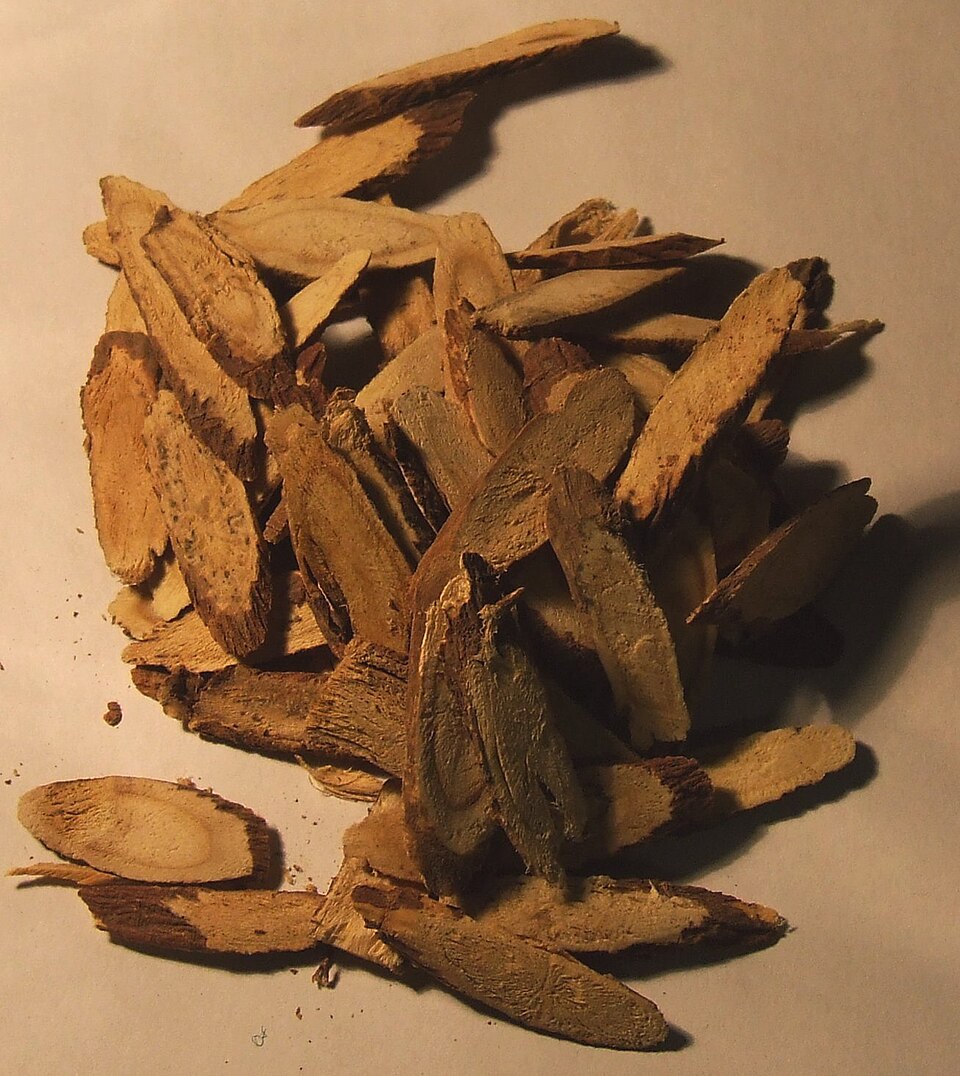
Licorice Root
Every episode this season has been about a plant whose reputation outran its evidence. Licorice inverts that. The effect is real, the mechanism is understood, and the FDA has published a warning with a number in it.
The Only One That Can Hurt You
Season 1 · Episode 12
Most of this season has run the same way. A plant arrives carrying an enormous reputation, we go looking for the evidence, and the evidence turns out to be one small study, or a mouse, or a mechanism mistaken for an outcome.
Licorice inverts it.
Here the effect is real, the mechanism is understood down to the enzyme, and the US Food and Drug Administration has published a consumer advisory with a quantity and a duration in it. This is the one plant in our blend that can genuinely hurt somebody, and the honest thing to do is put that first rather than at the bottom in small type.
The enzyme
Licorice root's sweetness comes from glycyrrhizin, also called glycyrrhizic acid. Glycyrrhizin and its active metabolite inhibit an enzyme called 11-beta-hydroxysteroid dehydrogenase type 2.
That enzyme has a specific job. In the kidney, it converts cortisol into inactive cortisone, and it does that to protect the mineralocorticoid receptor. Cortisol circulates at concentrations far above aldosterone and will happily activate that receptor if nothing stops it. The enzyme is what stops it.
Inhibit the enzyme and cortisol stays on the receptor. What follows is mineralocorticoid excess with no excess of the mineralocorticoid: sodium retained, potassium lost in the urine, water held with the sodium, blood pressure up from the volume, and potassium down far enough to cause muscle weakness, cramping and disturbed heart rhythm.
The clinical name is pseudohyperaldosteronism, because it looks exactly like aldosterone excess while aldosterone itself is low.
The advisory
The FDA's consumer advice on black licorice says that eating two ounces a day for at least two weeks could cause an irregular heart rhythm. It names people aged forty and over as the higher-risk group, because potassium tends to fall with age and the body handles the compound less efficiently.
Two ounces. Two weeks. Forty and over. Those numbers are the reason this plant gets a whole section instead of a sentence.
Being honest about our own limits here: we could not retrieve the individual published case reports with their figures, the patient details, the amounts, the serum potassium readings and the outcomes. The syndrome is thoroughly documented in the clinical literature and severe cases including deaths are on the record. We are not going to invent the specifics to make the paragraph land harder.
The same applies to the regulatory intake numbers. The World Health Organization has a provisional tolerable daily intake for glycyrrhizin and the commonly cited figure is 0.1 mg per kilogram of body weight per day, but we could not retrieve the primary document to check its exact wording, so treat that figure as needing verification rather than as quoted.
The arithmetic, shown rather than asserted
Licorice root is three quarters of one part in sixteen and a half. That is about 4.5 percent of the blend by weight.
A two gram teaspoon of the blend therefore holds roughly ninety milligrams of licorice root. Only a fraction of its glycyrrhizin comes out in a ten minute infusion.
The advisory figure is two ounces, about fifty-seven grams, of black licorice confectionery, eaten daily for a fortnight. That confectionery, where it contains licorice at all, is largely concentrated extract.
So the gap is roughly three orders of magnitude, and the materials aren't the same material. Candy is concentrated extract; tea is a dilute infusion of raw root.
That is a statement of proportion and not a claim of safety. Anyone drinking licorice daily in quantity, or taking diuretics, blood pressure medication or corticosteroids, or living with hypertension, kidney disease or low potassium, should treat this plant carefully and talk to a clinician. It isn't suitable in medicinal amounts during pregnancy or breastfeeding.
Most black licorice isn't licorice
This is where the advisory gets genuinely confusing, and it's worth understanding before it confuses you.
A large share of what's sold as licorice candy is flavoured with anise or star anise rather than licorice root. Both contain anethole, which reads as sweet and licorice-like on the tongue and is chemically unrelated to glycyrrhizin.
Anise carries no glycyrrhizin. It carries none of the mineralocorticoid problem described above.
Which produces two people making opposite mistakes. Someone worried about licorice may be eating anise and worrying about nothing. Someone reassured that their candy is "just licorice" may be eating concentrated extract. The ingredient list is the only reliable guide, and the word on the front of the bag is not one.
Sweet root
The name is a description. Licorice comes through Latin from the Greek glukurrhiza, sweet root, from glukus and rhiza. That's the same glukus behind glucose and glycerine, and the same rhiza behind rhizome.
Glycyrrhizin is roughly thirty to fifty times sweeter than sucrose by weight, and it behaves differently in the mouth. Sugar peaks fast and clears fast. Glycyrrhizin arrives slowly, stays, and leaves a faint bitter tail at the back. That's why a small quantity goes a long way and why too much makes a blend taste of nothing else.
It's also worth knowing that licorice in trade isn't one plant. The genus holds around twenty species. Glycyrrhiza glabra dominates Western commerce. G. uralensis is the Chinese one, and G. inflata appears in the Chinese pharmacopoeia too. Chemically close, used similarly, not interchangeable in every regulatory context, and the trade doesn't always distinguish them.
The harmoniser
In the Chinese materia medica, gan cao, sweet herb, appears in a large share of the classical formulas. Its described role is to harmonise: to moderate the harsher actions of the other ingredients and pull the formula together.
That's a formulation idea rather than a pharmacological finding, and it's the closest thing in another tradition to what we call the Ratio Doctrine. A herb enters at the proportion that holds the blend in balance. Licorice is in this blend as a background sweetener and a harmoniser, and at 4.5 percent it's doing the job the Chinese formularies gave it.
What we're claiming
Nothing, medically, as always.
What's different about this one is that the caution isn't a formality. Every other plant this season has been a story about claims outrunning evidence. Licorice is the one where the pharmacology is settled, the harm is documented, and the only thing standing between a pleasant sweet root and a hospital admission is how much of it you eat and for how long.
Ninety milligrams in a teaspoon. Fifty-seven grams a day for two weeks in the advisory.
Further reading
Sources consulted for this article and its episode are listed at the bottom of the page.
Photograph: Erin Silversmith, CC BY-SA 4.0, via Wikimedia Commons