
Journal ·
Mandrake
Everyone knows the mandrake screams when it is pulled, and that story has exactly one traceable source: Pliny the Elder, first century CE, reporting a belief at second hand.
The Scream With One Source
Season 1 · Episode 16
Everyone knows what a mandrake does.
You pull it from the ground and it screams, and the scream kills whoever hears it, so you tie a dog to the root and let the dog pull, and the dog dies instead of you.
Hardly anyone knows where that came from. It has one traceable source. Pliny the Elder, Naturalis Historia, book 25, first century CE, describes digging around the root and the ritual used to lift it, and he is reporting a belief at second hand. A compiler, not a witness.
Everything after Pliny is Pliny, repeated. The medieval herbals repeat him. Shakespeare assumes an audience that already knows him. The mandrake in Harry Potter is his direct descendant by way of those herbals. Two thousand years, one compiler.
The plant under the story
Mandragora officinarum is a stemless perennial of the Mediterranean basin and the Near East, and it is a nightshade. Solanaceae, the same family as deadly nightshade, henbane and jimsonweed.
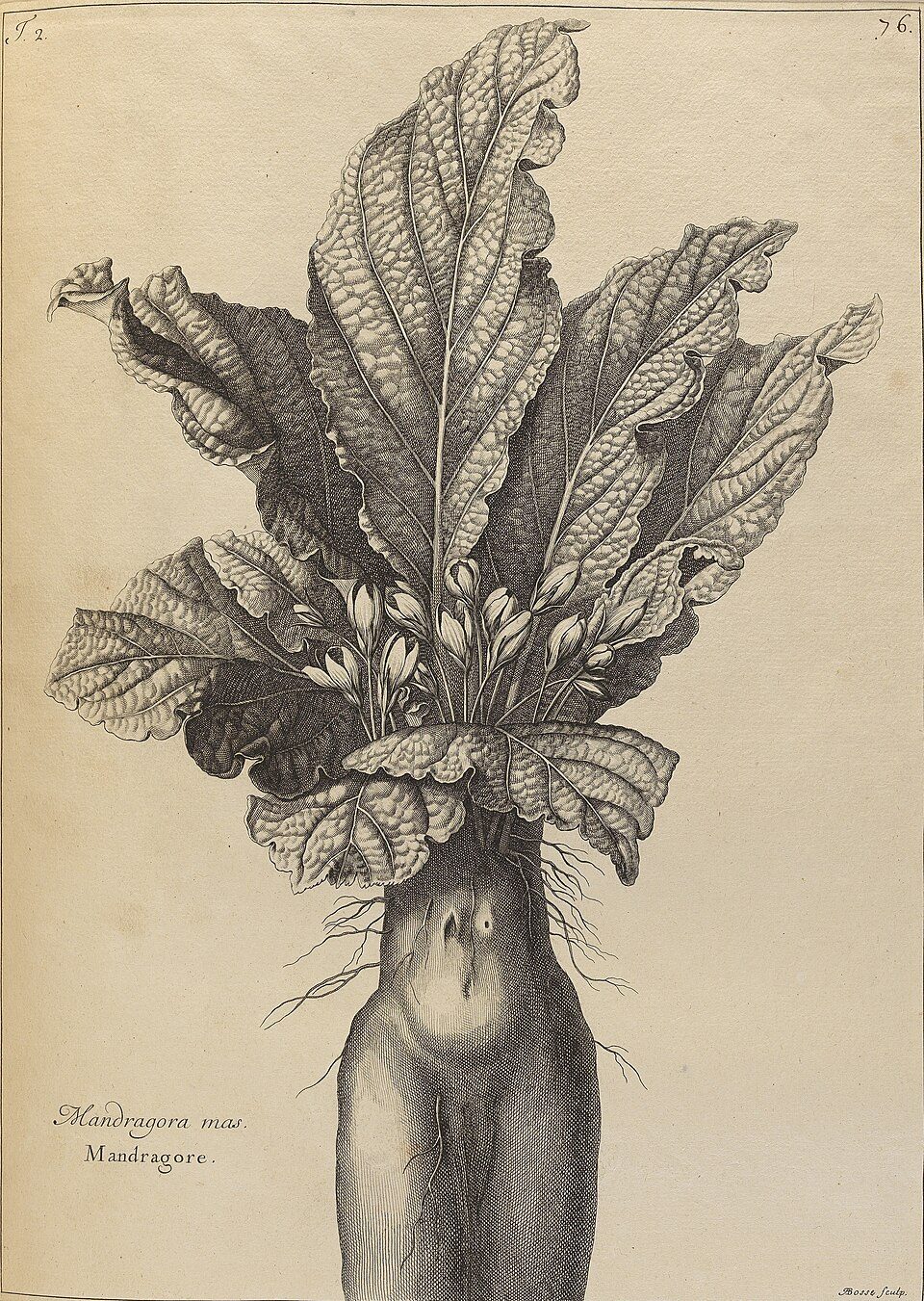
It grows as a flat rosette of broad, wrinkled leaves pressed against the ground, with bell-shaped flowers borne at ground level and a globose berry, yellow to orange when ripe, that is fragrant.
Fragrant is not food. The berry carries the same alkaloids as the rest of the plant, and the smell is the reason it keeps being described as though it were edible.
Underneath is a thick, fleshy taproot that often forks. That fork is the engine of the entire legend.
Even the species boundary is unsettled: some treatments separate M. officinarum from M. autumnalis and others merge them, so a statement about one is not automatically a statement about the other.
The other mandrake
There is a second plant with the same name and it is not a relative. American mandrake is Podophyllum peltatum, the mayapple, a woodland perennial of eastern North America in the barberry family, Berberidaceae. Settlers gave it the name on a resemblance of habit or use. The two are unrelated and both are toxic.
That matters outside botany. Mandrake root is sold in occult supply catalogues and novelty lines, and we could not source any of those products to a verified botanical identity. Anyone buying mandrake should establish which plant is in the bag.
The drake was never a dragon
English mandrake runs back through Latin mandragora to Greek mandragoras, and the origin of the Greek is uncertain.
What it is not is man plus drake. The drake ending is a later English reshaping of a word that arrived whole, encouraged by the human shape of the root. A folk etymology hitched the plant to a dragon and the dragon stayed.
The paper trail is long and thin. Mandrake is usually listed among the substances in the Ebers Papyrus, the Egyptian compilation dated to around 1550 BCE; that attribution is standard in secondary writing and we could not source the passage, so it stays flagged. Theophrastus has the plant in the fourth century BCE. Dioscorides gives it a full entry in the first century CE, with a male and a female form, the root, the fruit, and a wine.
The two famous details are not classical
The gallows is the detail people remember after the dog: mandrake said to grow beneath a hanged man, from what falls from him.
It is not in Pliny. It is not in Dioscorides. We could not source it to any classical text and we could not establish where it came from. It is a later European accretion, routinely merged with the ancient account as though it had always been part of it.
It is also the kind of story that has consequences. Attach a plant to the gallows and to the condemned, and you have given somebody a reason to prosecute the people who gather it.
The second late addition is gentler. German-speaking Europe kept the carved root as a household spirit, the Alraun, dressed and fed and inherited. Folklore, labelled as folklore, and a domestic familiar rather than a plant of the herbals.
Where the legend meets the chemistry
The root and leaves carry tropane alkaloids: hyoscyamine, scopolamine, and atropine, which is largely the racemisation product of hyoscyamine. The same compounds that make deadly nightshade, henbane and jimsonweed what they are.
The poisoning picture is well described in the medical literature. Dry mouth and skin, dilated pupils, blurred vision, flushing, tachycardia, urinary retention, confusion, agitation, hallucinations, and at higher doses seizures, coma and death.
A mechanism is not a benefit. These compounds are centrally active, which is what explains the sleep the old sources describe, and it explains the deaths in the same sentence.
Every old preparation concentrates it
Mandrake wants a dry summer, a wet winter, sharp drainage and full sun. It is slow from seed, usually grown from root division, and the root takes years to reach a size worth lifting. We could not source a cultivation protocol, a yield or a time to harvest, and we are not inventing one.
The historical preparations all run in one direction. A root macerated in wine, which Dioscorides describes. A tincture, in the manner the dispensatory tradition applied to the other narcotic plants of the family. An expressed juice. A poultice for painful joints.
Every one of them concentrates. Concentration is the hazard, and it is the opposite of steeping a leaf.
Long use, no trial
Two thousand years of documentation, and we could not source a single controlled human study of Mandragora officinarum.
The one claim that holds steady from Dioscorides and Pliny through the herbals is sleep, heavy enough to read as death. That is the reputation Shakespeare is leaning on when Cleopatra asks for mandrake and when the friar's potion is compared to it. Shakespeare is not a source about the plant; he is evidence that the reputation was common knowledge.
The nineteenth-century dispensatories placed mandrake among the narcotics and antispasmodics. We could not source the entry text, so the placement is all we will claim.
The fertility use, the most repeated claim of all, has no primary text we could find. It is very likely a back-formation from the shape of the root, helped along by Genesis 30, where Rachel and Leah bargain over dudaim, rendered as mandrake in many English Bibles. The botanical identity of dudaim is contested and we could not source a settled one. A translation choice is not a botanical fact.
Tropane alkaloids act on the same receptors as a number of prescription drugs, and anticholinergic burden adds up. Folk tradition held that this root brought sleep. The sentence stops there.
The absence that says something
Mandrake has been continuously documented for more than two thousand years, and no cuisine anywhere ever found a use for it.
Humans are extremely good at finding food uses for plants that can be eaten safely, in ordinary quantities, by ordinary people. When a plant this famous and this well described has no food tradition at all, that gap is not an oversight. It is information.
The folklore is abundant, specific and literary. The botany is sparse and general. That is the reverse of how a plant usually arrives in a library, and the honest position is to hold both and say plainly which is which. Repeat the legend as fact and you do harm. Throw the legend out and you lose the only reason anyone remembers the plant at all.
In the blend
Mandrake's share of Buckshot & Gunpowder is zero.
It is not in the blend, it will not be, and after all of the above you know why. There is no proportion at which a plant with no safe domestic width sits in a formula.
What is in the cup is sixteen and a half parts of things made to be drunk, with the black peppercorn heat arriving at the back after you swallow. Hand-blended in small batches by a family in the Bozeman valley, Montana.
Further reading
Sources consulted for this article and its episode are listed at the bottom of the page.
Photograph: Denis Dodart / Nicolas Robert / Abraham Bosse