
Journal ·
Meadowsweet
Meadowsweet gave aspirin its name but not its first isolation, and Culpeper catalogued the plant while missing the one thing it is now sold for.
The Plant That Named the Aspirin
Season 1 · Episode 6
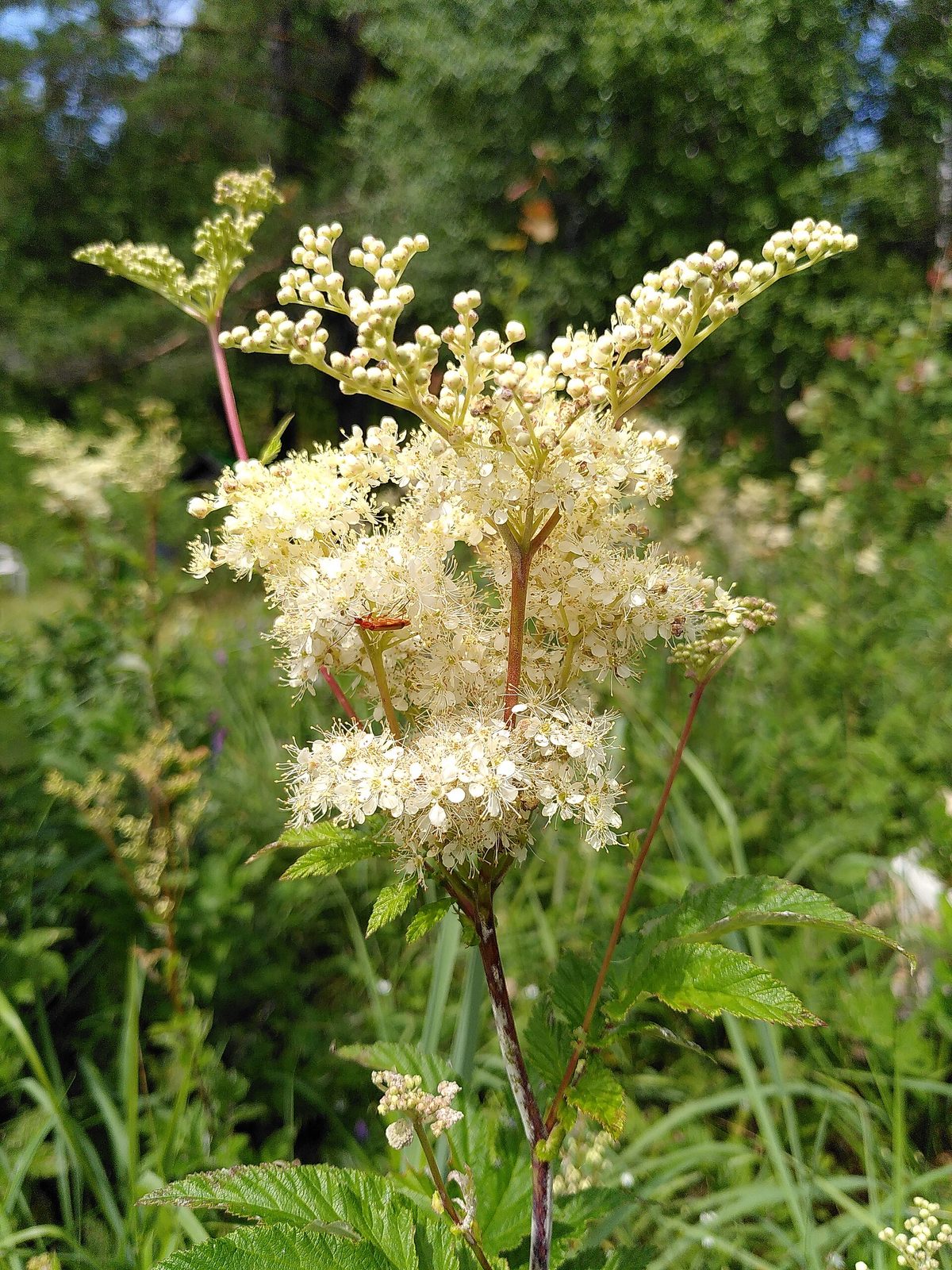
Crush a meadowsweet flower and it smells of almonds. Crush the leaf and it smells of something closer to antiseptic. The two scents come from the same chemistry, and that chemistry is why the plant sits at the root of the most widely taken drug in the world.
The name is the first thing that's usually wrong about it. Meadowsweet doesn't mean the sweet plant of the meadow. It dates from the sixteenth century and meant a plant used for sweetening or flavouring mead, and the older fifteenth-century form was "meadsweet." The Botanical Society of Scotland takes the etymology back further, to the Anglo-Saxon meodu-swete, mead sweetener. Chaucer has it in The Knight's Tale as "meadwort," an ingredient in a drink called save.
Its other names are a list of jobs: queen of the meadow, meadow-wort, lady of the meadow, dollof, bridewort. The last one comes from being strewn in churches for weddings and worked into bridal garlands.
The herbals can actually be used here
This is the rare herb where the seventeenth-century record is both deep and about the right plant.
Rooibos was hard because the written record is nearly empty. Peppermint was hard because the record is enormous and belongs to a different species. Meadowsweet grew across Britain and northern Europe, where the herbalists lived and worked, so when Gerard or Culpeper writes about it they're describing something they've handled.
Gerard's Herball of 1597 is worth quoting at length, in the version the Botanical Society of Scotland reproduces:
"The leaves and flowers far excel all other strewing herbs, for to deck up houses, to strew in chambers, halls, and banqueting houses in the summertime; for the smell thereof makes the heart merry, delighteth the senses: neither doth it cause headache, or loathsomeness to meat, as some other sweet smelling herbs do."
One honest caveat about that quotation. It's read second-hand, in John Grace's 2024 article quoting Gerard, not in a scan of the 1597 text. It's attributed to the right book and year, and it should carry that label until someone reads the original.
The related claim, that meadowsweet was Elizabeth I's favourite strewing herb and that she desired it above all others in her chambers, is sourced too, but to Toni Mount's Dragon Blood & Willow Bark of 2015, a popular history rather than a primary document. The strewing line is Gerard's. The Elizabeth claim is Mount's. They're two different claims and they get merged constantly.
Culpeper had it in front of him and missed it
Culpeper's The Complete Herbal of 1653 files the plant under the heading "QUEEN OF THE MEADOWS, MEADOW SWEET, OR MEAD SWEET." He puts it under Venus. He describes the stalks as "reddish, rising to be three feet high, sometimes four or five feet," the leaves "hard, rough, or rugged, crumpled much like unto elm leaves," with "a pretty sharp scent and taste, somewhat like unto the Burnet," and adds that "a leaf hereof put into a cup of claret wine, gives also a fine relish to it."
His virtues are astringent and settling. It stays bleedings and fluxes and vomitings, helps those troubled with the cholic, and boiled in red wine will stay the flux of the belly. The water of it helps heat and inflammation in the eyes.
Now read that list again for what isn't in it. No pain. No joints. No rheumatism. No fever. The uses meadowsweet is sold for today are absent from the entry of the man who catalogued it most carefully. The Botanical Society of Scotland makes the same observation: Culpeper "still seems to have missed the most significant virtue of this plant."
He couldn't have done otherwise. The chemistry that makes meadowsweet interesting to a modern buyer had no name in 1653.
Where aspirin got its name, and where it didn't
The tidy version of this story is that salicylic acid was isolated from meadowsweet and became aspirin. The tidy version collapses two plants into one.
The name is genuinely meadowsweet's. The plant's older botanical name was Spiraea ulmaria, and salicylic acid was called Spirsäure in German after it. Bayer built "Aspirin" from that in January 1899: a- for the acetylation, -spir- from Spirsäure, and -in as a drug-name ending.
The isolation is willow's. The sequence, from Wikipedia's history of aspirin, runs: Johann Buchner obtained relatively pure salicin crystals from willow bark in 1828; Pierre-Joseph Leroux developed another willow extraction in 1829; Johann Pagenstecher extracted a substance from meadowsweet in 1834 and suggested it might have therapeutic value; Raffaele Piria obtained a more potent acid form from willow in 1838 and named it salicylic acid; and Karl Jacob Löwig, working on the Spiraea extract, then realised it was the same compound.
So meadowsweet gave the drug its name and a parallel isolation. Willow gave it the first clean one.
The sources don't fully agree even on that. Wikipedia's Filipendula ulmaria article says Piria obtained salicylic acid from the buds of meadowsweet in 1838, and the Botanical Society of Scotland gives 1839 for an isolation from meadowsweet. Three accounts, three slightly different versions of the same event. That seam is exactly what popular retellings paper over, and it's more honest to show it than to pick one.
Worth adding, because the conflation runs both ways: the standard claim that willow was an ancient painkiller doesn't hold either. Wikipedia's history of aspirin is blunt about it. "Numerous authors have claimed that willow was used by the ancients as a painkiller, but there is no evidence that this is true. All such accounts date from after the discovery of aspirin." Celsus recommended willow leaves for uterine prolapse. Culpeper gave many willow uses, none of them analgesic.
The plant contains no aspirin
Aspirin is acetylsalicylic acid, and it doesn't occur in nature. It was first synthesised in 1899.
What meadowsweet contains is salicylate precursors: the glycosides monotropitin and spiraein, the volatile salicylaldehyde and methyl salicylate that produce the almond scent, and a little free salicylic acid. By weight it's more a tannin herb than a salicylate herb, carrying ellagitannins in quantity. The flavonoid spiraeoside is named for the plant.
The glycosides are stored sugar-bound and released mainly by gut bacteria, which makes the onset slow and the delivered dose dependent on an individual's own microbiome. Nobody can tell you their dose.
That matters for the claim the plant is usually sold on, which is that it's a gentler aspirin: salicylates for the effect, tannins to protect the stomach. Dr Christopher Hobbs writes that its salicylate content makes it beneficial for pain relief but gentler than synthetic drugs. The mechanism has preclinical support, including gastroprotection data from Samardžić and colleagues in the Journal of Ethnopharmacology in 2018, but that work is in animals and cells.
The honest summary of the human evidence is an absence rather than a negative. There are effectively no adequate controlled human trials of meadowsweet for any indication. Not failed trials. No trials. German Commission E permitted it as supportive therapy for colds on a monograph built from tradition rather than trial data, and the European Medicines Agency holds a herbal monograph for Filipendulae ulmariae herba on the same basis.
The safety reasoning runs opposite to the marketing. Acetylation is what produces irreversible COX inhibition and the classic gastric injury, and non-acetylated salicylate drugs are less gastrotoxic, but that's a fact about drugs applied by inference to a herb. An unmeasurable dose isn't a safety feature. The ordinary salicylate cautions apply: salicylate sensitivity and aspirin-exacerbated respiratory disease, anticoagulants, active peptic ulcer disease, pregnancy, and the Reye's syndrome caution that the CDC's Surgeon General's Advisory states for children with influenza and chickenpox.
Meadowsweet is the plant that named the drug and never contained it.
Further reading
Sources consulted for this article and its episode.
- botsoc.scot — plant of the week july 29th 2024 filipendula ulmaria meadowsweet - christopherhobbs.com — meadowsweet - doi.org — 10.1006/jasc.1994.1014 - doi.org — 10.1007/s00334-013-0419-x - en.wikipedia.org — Filipendula ulmaria - en.wikipedia.org — History of aspirin - factowiki.com — meadowsweet - foragerchef.com — meadowsweet flowers - myhealthcare.com — Benefits - theherbalmedic.co.uk — meadowsweet filipendula ulmaria - cdc.gov - ema.europa.eu — filipendulae ulmariae herba - gutenberg.org - harrisdistillery.com — the magic of meadowsweet - ninds.nih.gov — reyes syndrome - researchgate.net — 351284406 The Name and Taste of Indo European Mead
Photograph: Krzysztof Ziarnek, Kenraiz, CC BY-SA 4.0, via Wikimedia Commons