
Journal ·
Nettle Leaf
A fairy tale about shirts woven from nettles, a Scottish proverb about housewifery, and a wartime story that everyone repeats and the source denies.
The Housewifery of the Nettle
Season 1 · Episode 4
In 1838 Hans Christian Andersen published a story in which a princess is set an impossible task. To break the enchantment on her eleven brothers, Elisa must weave each of them a shirt out of nettles. She gathers the plants with bare hands. She is forbidden to speak while she works. Her hands blister.
Every part of that is a fairy tale except the shirts.
Nettle cloth was a real thing, made by real households, for centuries. The fibre was retted like flax, spun, and woven into a linen-like fabric. Andersen's readers in 1838 would not have needed the craft explained to them, because it was still within living memory across northern Europe. The magic in the story is the swans. The nettles are documentary.
So well known they need no description
The most quoted line ever written about this plant is Nicholas Culpeper's, and it is a joke.
The Complete Herbal of 1653 opens its nettle entry like this: "NETTLES are so well known, that they need no description; they may be found by feeling, in the darkest night."
It survives because it is funny and because it is true. Nettle is the plant you identify by accident. It grows in waste ground, along hedges, on the edges of every neglected place, and it announces itself.
Culpeper is worth pausing on for a second reason. He refused to write about fenugreek, our previous herb, on the grounds that "I write not of exoticks." Nettle needed no such excuse. It was underfoot, and it got a full entry.
Four compounds, not one
The sting is the most reliably documented thing about the plant, and it is chemistry rather than a health claim.
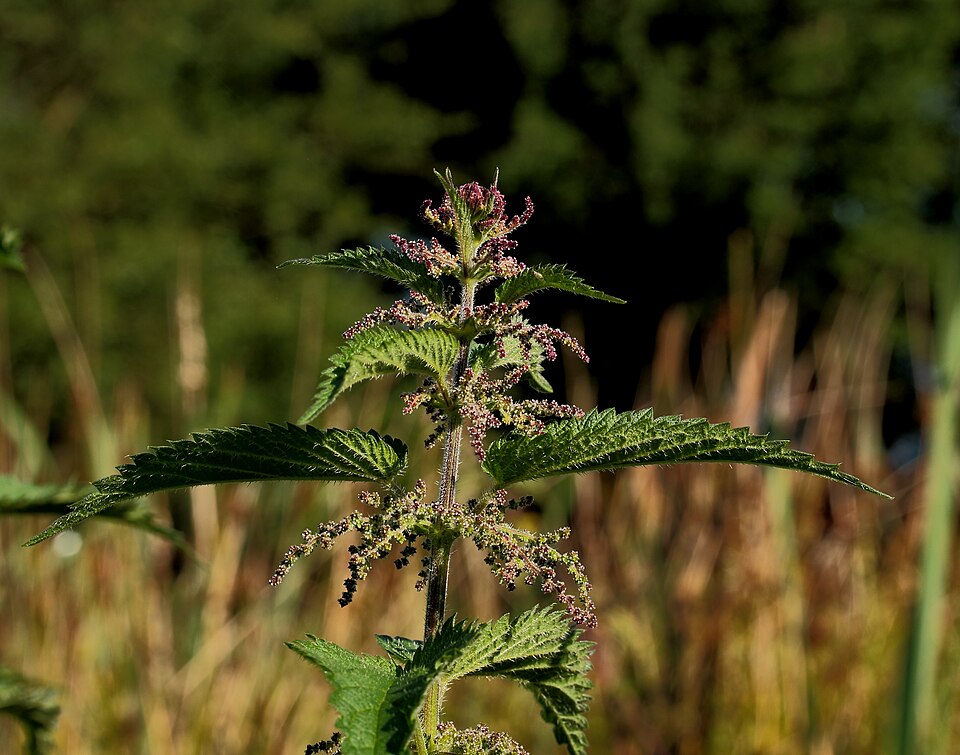
The stinging hairs are trichomes: small, hollow, needle-like structures, each tipped with a bulb. Brush against one and the bulb snaps off, leaving a sharpened tube that pierces the skin and injects what it holds.
Phelps Brown's The Complete Herbalist of 1878 gives the classic account: "The prickles of the Common Nettle contain Formic Acid." That is the same compound that puts the bite in an ant sting, and it is the root of the plant's Latin name, from urere, to burn.
It is also only part of the answer. Modern pharmacological description puts four things in the sting rather than one. Formic acid, histamine, acetylcholine, and serotonin. The histamine raises the welt and the itch. The acetylcholine produces the burn. The serotonin carries the pain.
Now the practical consequence, which is the fact that makes the whole plant usable. Those hairs are fragile and those compounds are volatile and water-soluble. Heat destroys them. Drying destroys them. Dried nettle does not sting, cooked nettle does not sting, and every anxiety anyone has ever had about eating this plant is answered by a saucepan.
The housewifery of the nettle
Here is the line that ought to be famous, and is not.
Charles F. Saunders, in Useful Wild Plants of the United States and Canada of 1920, quotes an older writer by way of Richard Prior's Popular Names of British Plants: "Scotch cloth is only the housewifery of the nettle."
Read it twice. It is not saying nettle cloth resembled Scotch cloth. It is saying that Scotch cloth was nettle, worked at home, by hand, as ordinary domestic labour. Not a craft revival, not a curiosity. Housewifery.
That is what nettle was for most of its recorded history in Europe: a textile. Free, abundant, growing on ground nobody wanted, and convertible by patient work into cloth you could wear. It was a poor household's linen.
Saunders also records something that complicates the neat European picture. "The Nettle, indeed, has been a primitive source of thread in both hemispheres." He notes that various nettle species, "soaked in water, yield a fiber for cord making, as the Indians long since discovered," and that the California Indians pounded out the root of a nettle species to secure a strong thread.
Europeans used the stem. Californians used the root. Neither knew about the other. They arrived at the same plant independently, on opposite sides of the world, and got cordage out of it both times.
The uniforms that were not
Search for nettle and you will be told that German soldiers in the First World War wore uniforms made from nettle fibre. It appears in nearly every article about the plant.
The claim is a distortion, and the correction comes from the source people cite it against.
Nettle fibre was genuinely investigated as a wartime substitute for cotton in Germany and Austria-Hungary. That research programme was real. But Hubert Weitensfelder, writing for the Austrian First World War project on textiles and paper fabrics, states that the processing "was not followed up in practice to any significant extent," and that the better substitute for cotton turned out to be paper textiles.
So: studied, yes. Adopted at scale, no. The research happened and the uniforms did not.
This is the second time in two herbs that the most repeated story about a plant has failed on contact with its own source. Fenugreek had the embalming claim. Nettle has the uniforms.
What winter left behind
Nettle's oldest food tradition is the spring tonic, and Culpeper gives it in its most explicit English form, filtered through his astrology:
"You know Mars is hot and dry, and you know as well that Winter is cold and moist; then you may know as well the reason why Nettle-tops eaten in the Spring consume the phlegmatic superfluities in the body of man, that the coldness and moistness of Winter hath left behind."
Strip the planets and a plain observation is left. After months of salted meat and stored roots, the first green thing of the year mattered. Nettle was among the earliest and by far the most abundant. Phelps Brown records in 1878 that the young shoots were "boiled and eaten" against scurvy, which is his century's account of the practice and not a claim we are making.
The practice is not a wellness fashion. It is a documented centuries-old habit of eating the first greens available, and nettle was what was available.
What it is sold for, and what belongs to what
Three modern claims attach to this plant, and they have very different evidence behind them.
Researchers have studied nettle for seasonal allergies. The trials are small and the results mixed, and the claim remains preliminary rather than established.
Researchers have studied it for joint pain, where the tradition is genuinely ancient. Urtication, the deliberate application of nettle stings as a counter-irritant, has a long recorded history in which Pliny the Elder is usually named as the earliest source, with Galen and Dioscorides also recording nettle as a medicinal plant. We could not pin that attribution to a specific modern citation, so take it as the long-standing account it is. Either way, the clinical confirmation is thin.
The third claim is the one worth being precise about, because marketing blurs it constantly. The prostate research was done on the root. Urtica dioica radix is a different plant part from the leaf, with different constituents and its own separate research history. We use the leaf. The root's evidence does not transfer to it, and anyone selling you leaf on the strength of root studies is either confused or counting on you being.
In the cup
Nettle leaf brews as an infusion: boiling water, five to ten minutes, longer for a stronger cup.
What comes out is deep green and frankly savoury. Mineral, slightly grassy, closer to a vegetable broth than to anything delicate. It is not a sweet tea and it is not an aromatic one.
That is exactly why it works as a base. In Buckshot & Gunpowder, our thirteen-herb blend, nettle is week four and it does the job of depth. It sits under the rooibos and gives the sweeter, more aromatic seeds something to sit on.
If you gather your own, take the young tops in spring before the plant flowers, which Phelps Brown puts at June to September. Cut the tops rather than pulling the plant, because it is a perennial with a creeping root and it will come back. Wear gloves. Then dry it, and the gloves stop being necessary.
The plant that never had to be prized
Nettle has no glamour attached to it. It is not rare, not expensive, not tropical, and not at the centre of anyone's ceremony. It grows where nothing was planted and it hurts to touch.
It also clothed people, fed them at the end of winter, and was independently worked into thread by two populations who had never heard of each other. Culpeper found it in the dark on purpose, and expected his readers to laugh, because they all knew exactly what he meant.
Further reading
Sources consulted for this article and its episode.
- ww1.habsburger.net — fragile clothing textiles and paper fabrics - gutenberg.org
Photograph: Dominicus Johannes Bergsma, CC BY-SA 4.0, via Wikimedia Commons