Journal ·
Orange Peel
There are not many species of orange. There are three wild ancestors and a great many crosses, and our own bag does not say which one is in it.
Orange Is Not A Species
Season 1 · Episode 13
Ask how many species of orange there are and most people will guess a dozen. Navel, blood, Valencia, Seville, mandarin, tangerine, clementine.
The real answer is that almost none of those are species. They're crosses, and they descend from a very small number of wild ancestors.
The genomic work that settled it is Wu and colleagues, "Sequencing of diverse mandarin, pummelo and orange genomes reveals complex history of admixture during citrus domestication," published in Nature Biotechnology in 2014. It identifies the founders as citron, pomelo and mandarin, with a fourth wild group, the papeda, feeding into limes.
Everything else on the fruit stand is arithmetic done on those.
The arithmetic
The sweet orange, Citrus sinensis, is essentially a backcross of pomelo into mandarin.
The bitter orange, Citrus aurantium, is a different and older cross of the same two parents, with more pomelo in it. That is why the two taste nothing alike despite sharing ancestry, and it's why one of them makes marmalade and the other makes breakfast.
Grapefruit is a further cross, pomelo with sweet orange. Lemon involves citron and bitter orange.
So "orange" isn't a species. It's a category. And the practical consequence for anyone selling dried peel is that the peel of one orange is not interchangeable with the peel of another, chemically or traditionally.
Which one is in our bag
Ours says "granulated orange peel." That's the whole of it. No botanical name.
That's not unusual, and it's not sinister, but it is the episode's own point arriving in the kitchen. So we went and checked what the trade actually means by the phrase.
Three suppliers, three answers, all the same. Herbco lists its orange peel as Citrus sinensis. Mountain Rose Herbs gives "Botanical Name: Citrus x sinensis," origin Spain and Peru. Grassroots Herb Supply sells "Orange Peel, c/s, Citrus sinensis."
Culinary orange peel means sweet orange. Bitter orange exists in the same catalogues, and it's sold explicitly labelled as bitter orange, because the people buying it want the bitter one specifically.
So ours is sweet orange. A pomelo backcrossed into a mandarin, dried and granulated.
Why the distinction is worth the trouble
Because of one compound, and a piece of regulatory history.
Bitter orange peel contains protoalkaloids, principally p-synephrine, along with smaller amounts of octopamine, hordenine and tyramine. These are adrenergic amines. They act on the same receptor family as adrenaline.
In 2004 the US Food and Drug Administration banned ephedra from dietary supplements after deaths and serious cardiovascular events were linked to ephedra weight-loss products. The market moved to bitter orange, sold as a natural stimulant, usually stacked with caffeine.
That's a real topic and it deserves care. It also has almost nothing to do with a cup of tea.
Sweet orange peel doesn't carry synephrine at the same order of magnitude. And even for bitter orange, a standardised extract in a capsule, dosed for stimulant effect, is not dried peel steeped in water. The dose, the preparation and the intent are all different. That's the same gap the nettle, ginger and turmeric episodes turned on, and it doesn't close just because both things came off a citrus tree.
Two roads west
Citrus came from the region spanning southern China, northeast India, Myanmar and northern Indochina. It reached the Mediterranean in stages.
The citron went first and earliest, in the classical period, which is why it's the citrus Theophrastus knew.
The bitter orange arrived through the Arab agricultural expansion, established in Persia, then the Levant and North Africa, then Iberia and Sicily. The word came with it, from Arabic naranj, through Old French, into English as orenge.
The sweet orange came later and by a different route, generally described as reaching Europe through Portuguese traders in the fifteenth and sixteenth centuries.
Being honest about the limits here: the specific introduction date is usually given as around 1500 and attached to Vasco da Gama's route, and we could not source that to a primary document. Same for the early Chinese cultivation dates, which are widely repeated and which we did not trace to the underlying archaeology. They're left out rather than dressed up.
What the sequence does explain is why bitter orange has centuries of European cooking, medicine and distilling behind it while the sweet orange is comparatively new.
The peel was the article of trade
Dried peel travels better than fruit. It dries hard, holds its oil, and ships in sacks, and in northern Europe the dried peel had a longer commercial history than the fresh orange did.
In the European materia medica it appears as aurantii cortex, and it's the bitter orange that carries the pharmacological reputation in those texts.
Culpeper's The English Physitian of 1652 doesn't give orange peel an entry of its own. It turns up inside compound waters, in Aqua Imperialis, alongside citron peel, nutmeg, cloves, cinnamon and a long list of aromatics.
That placement is the interesting part. The peel is a supporting aromatic in a formula, never the headline. Which is exactly the role licorice plays in the Chinese materia medica, and we said the same thing about it three weeks ago from the opposite side of the world.
Chen pi, and a quality claim made of time
The most distinctive thing anyone does with orange peel is Chinese, and it inverts a rule the rest of herbalism takes for granted.
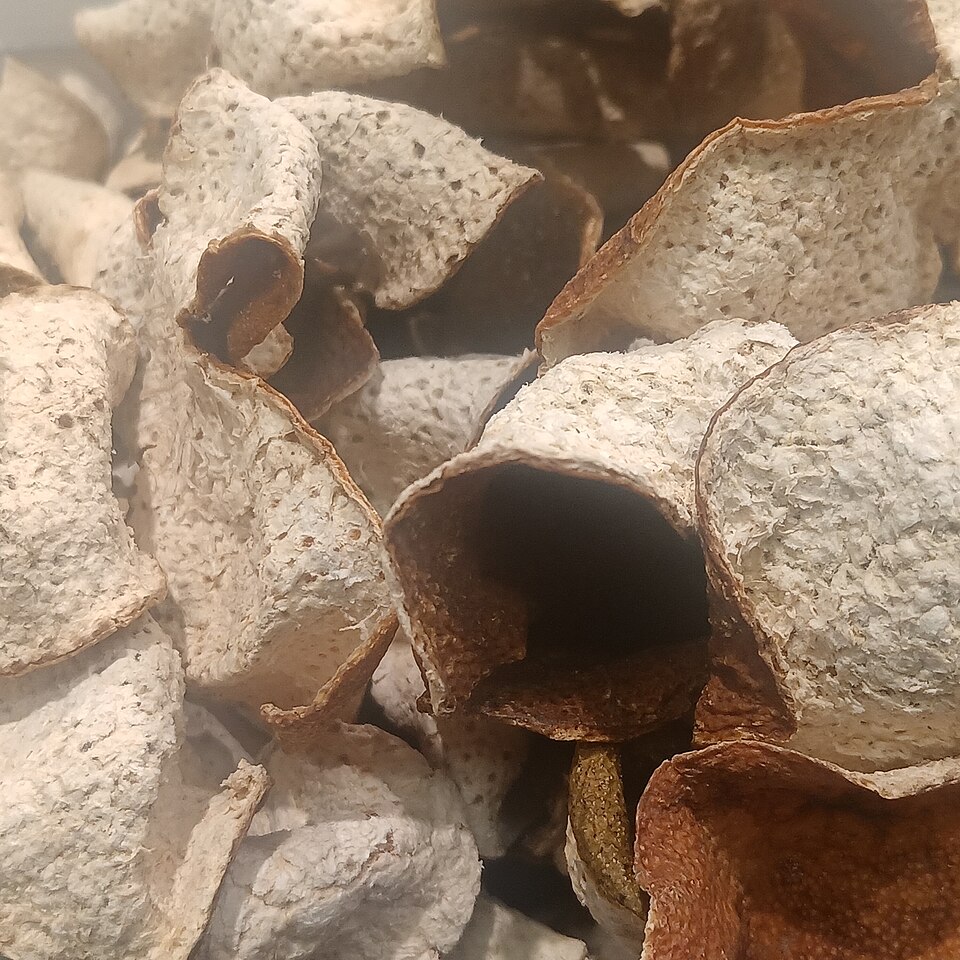
Chen pi means aged peel. Dried peel is stored for years, sometimes decades, before use, and older peel is held to be better peel. The market agrees: aged chen pi sells at prices fresh peel does not command, and the age of a batch is a claim a seller makes and a buyer pays for.
Almost everywhere else, fresher is better. Here the quality is carried by time, which is closer to how wine or pu-erh is sold than to how herbs usually are.
In the blend
Orange peel is three quarters of one part in sixteen and a half.
The aroma lives in the flavedo, the coloured outer layer, where the oil glands sit. The white pith underneath is where most of the bitterness is, which is why peel is graded and why how it's cut matters.
At that share it's a top note, the thing you smell before you taste anything.
What we're claiming
Nothing, medically. This is history.
What we can say is narrower and more interesting than a health claim. The bag says "granulated orange peel," and that phrase turns out to mean a specific hybrid: a pomelo backcrossed into a mandarin, whose peel dries hard enough to cross an ocean, and which the Chinese would tell you is not yet old enough to be worth much.
Further reading
Sources consulted for this article and its episode are listed at the bottom of the page.
Photograph: Fumikas Sagisavas, CC0, via Wikimedia Commons