Journal ·
Peppermint
A peer-reviewed paper disproved the claim that peppermint was found in Egyptian pyramids. Two years later it is still printed on tea boxes.
The Pyramid That Never Held It
Season 1 · Episode 5
Pull up a peppermint plant and you won't find a seedling. You'll find a runner: a pale cord of stem creeping sideways under the soil, rooting at every node, sending up a new plant wherever it touches. That's how peppermint travels, and it's the only way it travels. The plant is a hybrid of watermint and spearmint, it's sterile, and it sets no viable seed.
So every peppermint plant on earth is a cutting. Somebody divided one and planted the pieces, and somebody before them did the same, back and back to a single plant in a single field.
That field was in Hertfordshire, and the year was about 1696.
An archaeologist read the side of a tea box
Jesse Millek is an archaeologist of the ancient Near East. On a box of peppermint tea he read the sort of fact that gets printed on packaging: that dried peppermint leaves dating to 1000 BC had been found in the pyramids of Egypt.
Because of what he does for a living, he checked. In September 2024 he and the Egyptologist Lutz Popko published the result in History of Pharmacy and Pharmaceuticals under the title "Peppermint's Phony Pharaonic Past: Dispelling the Myth of Mentha piperita in Ancient Egypt." Their abstract doesn't hedge. Peppermint "was neither found in any Egyptian pyramid or tomb, nor was it prescribed in the Ebers Papyrus or other Egyptian medical texts."
Millek's own note on the pyramids is the part worth repeating. The pyramids of Giza are Old Kingdom, roughly 2500 BC, and they were emptied in antiquity. What has actually been found in them is bats, sand and rubble.
A sterile plant can't have an ancient history
The chronology isn't just unsupported. It's impossible, and the reason is the runner.
A plant that can't reproduce on its own doesn't establish wild populations. It can't disperse, it can't colonise, and it can't sit unnoticed in the flora of a river valley waiting to be discovered. It exists only where two conditions meet: watermint and spearmint growing close enough to cross, and a person who notices the odd pungent seedling and keeps it going by division.
That's not a botanical event. It's a cultivation event, and cultivation events have dates. Peppermint's are close together and well documented. A find in Hertfordshire published by John Ray in 1696. Admission to the London Pharmacopoeia in 1721. A binomial from Linnaeus in 1753, who treated it as a species in its own right before later botanists corrected it to the hybrid Mentha × piperita.
The hybrid is such a genetic patchwork that recorded chromosome counts vary between 66, 72, 84 and 120. That's what a plant looks like when it's held together by cuttings instead of seed.
One word, repeated for thirty years
The interesting part isn't that the Egyptian claim is wrong. It's that Millek could trace exactly how it was built.
He followed the citations backwards. The claim appears in Andrew Chevallier's Encyclopedia of Medicinal Plants of 1996, which says dried leaves "were found in Egyptian pyramids dating back from about 1000 BC." Chevallier appears to have drawn on a 1979 article by Jane LaRue, which said peppermint "has been found in Egyptian tombs dating back to 1000 B.C."
Tomb became pyramid. Millek's reading is that Chevallier simply equated the two, the pyramids being the most famous Egyptian tombs of all. One word changed, and a fact that had never existed was manufactured and then repeated for three decades.
A second error runs alongside it. The Ebers Papyrus, from about 1550 BC, records a plant called njꜣjꜣ used for breathing problems, and a nineteenth-century German translation rendered it Pfefferminz. It isn't peppermint.
And a third, facing the other way entirely: Chinese mint, bohe, comes from the fresh leaves of Mentha haplocalyx, a different species again. A Chinese materia medica cited for peppermint makes the same mistake in reverse.
Mint really is ancient. The oldest written references are attributed to Hammurabi of Babylon around 1800 BC, mint is tithed in the Bible at Matthew 23:23 and Luke 11:42, and the genus takes its name from Minthe, a nymph of Greek myth. All of that is true, and none of it is about this plant. Peppermint inherited a mythology by taking the family name.
The village that became a flavour
What peppermint has instead of a myth is Mitcham, in Surrey, on the water meadows of the River Wandle.
Daniel Lysons recorded "above 100 acres" of peppermint there in The Environs of London in 1792, and noted that demand wasn't confined to the apothecaries' shops, "it being much used in making a cordial well-known to the dram-drinkers." Peppermint was a drink for pleasure from the late eighteenth century, not only a medicine. Mitcham oil was judged the best exhibited at the Paris Exhibition of Industry in 1855.
Then it started to go. By 1875 the Canadian Pharmaceutical Journal was describing Mitcham cultivation in detail and already reporting declining yields, noting that a crystallised peppermint oil newly arrived from Japan was "not greatly inferior in point of fragrance to the best Mitcham oil" and could be supplied more cheaply. The end of an industry, visible in the trade press while it was happening.
The plant emigrated and kept moving: Massachusetts in the early 1800s, New York in the 1830s, the Midwest, then out to Oregon, Washington and Idaho in the early 1900s to escape Verticillium wilt in the soil. By 2014 the Pacific Northwest accounted for 84% of United States production. In 2023 world production was 35,547 tonnes, led by Morocco with 78% and Argentina with 20%.
England found it, America industrialised it, and North Africa grows it. The Mitcham name survives only in the cultivars: 'Mitcham Digne 38', 'Todd's Mitcham', 'Roberts Mitcham', grown by people who have never seen the place.
The cold that isn't cold
Menthol was first isolated from peppermint oil in 1771, and the compound wasn't named until 1861. Dried peppermint carries roughly 0.3 to 0.4% volatile oil, and that oil runs about 41% menthol and 23% menthone.
What menthol does is the best thing in the plant. It activates TRPM8, the cold receptor, cloned in 2002 by two groups working independently, and it shifts that channel's activation threshold to warmer temperatures. The nerve then reports cold that isn't happening.
Nothing gets colder. No thermometer moves. The receptor lies, and the brain believes it, because the brain has no other way of knowing what the skin is feeling. That's why a hot cup of peppermint tea still reads as cool in the mouth. Eucalyptol works on the same receptor, which is why eucalyptus does it too.
What the evidence actually covers
Peppermint oil for irritable bowel syndrome is one of the better-evidenced herbal claims there is. The most comprehensive meta-analysis is Alammar and colleagues, "The impact of peppermint oil on the irritable bowel syndrome," in BMC Complementary and Alternative Medicine 19:21, published 17 January 2019.
The distinction that matters is the preparation. Every trial in it used enteric-coated peppermint oil capsules, designed to release in the small intestine. A standard cup of peppermint tea carries roughly 5 to 20 mg of peppermint oil equivalent, against 187 to 225 mg in a single capsule, before the three-times-daily dosing is counted at all. No trial has tested the tea.
We sell the leaf. Treating capsule evidence as tea evidence is the error this whole subject invites, and it's the same shape as the nettle root-versus-leaf distinction. The cautions belong here too, stated as cautions: peppermint and menthol can aggravate reflux by relaxing the lower oesophageal sphincter, which is the same mechanism that does useful work elsewhere.
Two years after a peer-reviewed paper took the Egyptian claim apart, the boxes still say Egypt.
Further reading
Sources consulted for this article and its episode.
- anetoday.org — pyramid peppermint - en.wikipedia.org — Minthe - en.wikipedia.org — Peppermint - hopp.uwpress.org - ibs.ie — peppermint oil ibs - invasions.si.edu — mentha%20x%20piperita - lcme.wsu.edu — peppermint - mertonhistoricalsociety.org.uk — mitcham herbal industries - mitchamhistorynotes.com — peppermint in 1875 - drugs.com — menthol topical - theoi.com — NympheMinthe
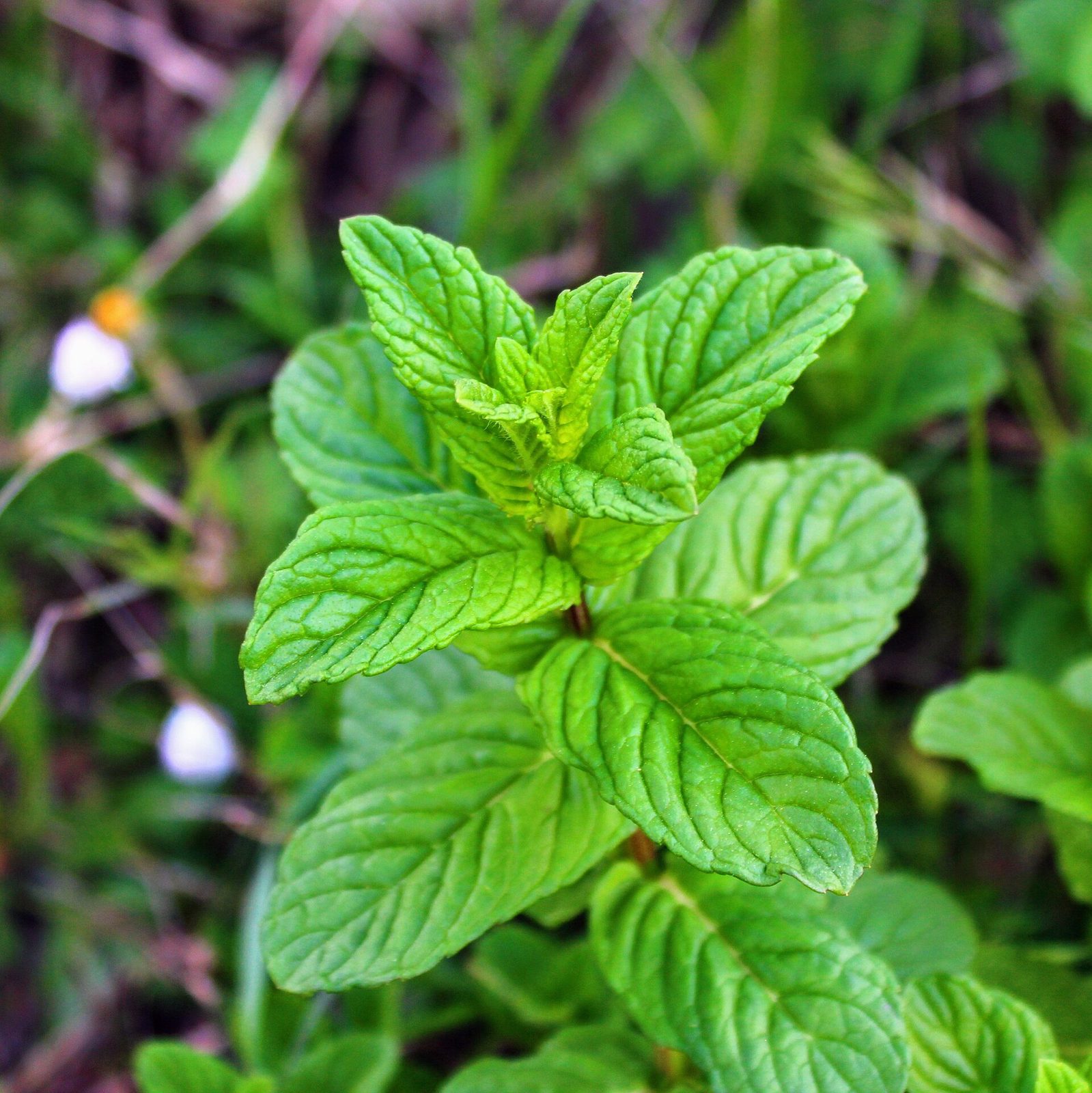
Photograph: Kızıl, CC BY-SA 4.0, via Wikimedia Commons