
Journal ·
Rooibos
A pea-family shrub from one mountain range, a red that is manufactured rather than grown, and the ancient tradition behind it that nobody has ever been able to find in the record.
The Ant Heap and the Red Bush
Season 1 · Episode 2
Rooibos is not tea, and the red is not natural.
Both of those are worth sitting with. True tea, all of it, black and green and oolong and white, comes from one plant. Rooibos comes from another one entirely: Aspalathus linearis, a fine needle-leaved shrub in the pea family, closer kin to beans and clover than to anything in a teapot. Like its legume cousins it makes its own nitrogen through bacteria in its root nodules, which is most of how it survives ground too poor to interest anything else.
And the bush is green. Cut it and it stays green. The red arrives later, after the leaf is bruised and heaped and left to oxidise in the sun, a step the trade calls fermentation though no yeast is involved. Green rooibos is the same plant with that step skipped. So "red tea" names the colour in the cup, and the colour in the cup is a decision somebody made.
It grows in one place
The Cederberg, a range of weathered sandstone a few hours north of Cape Town, and a narrow band of neighbouring districts. Nowhere else on earth, in the wild.
The South African National Biodiversity Institute's entry, written by Marcini Govender of the National Herbarium in 2007, puts the natural range in the winter rainfall zone from Vanrhynsdorp down to the Cape Peninsula, on acid sandy soils taking 300 to 350 mm of rain a year. Cold wet winters, hot dry summers. The seed will not germinate unless its hard coat is broken first, and a planted bush takes twelve to eighteen months before anyone cuts it.
People have tried to grow it elsewhere. It has not worked at scale.
The story everybody tells
Search for rooibos and you will be told it is an ancient drink of the Khoisan, brewed in the Cederberg for centuries before any European arrived. It appears on packaging, in trade copy, and in most of the articles written about the plant.
The leading scholarly review of precisely that question does not support it.
Ben-Erik van Wyk and Boris Gorelik, in The history and ethnobotany of Cape herbal teas (South African Journal of Botany 110, 2017, pages 18 to 38, DOI 10.1016/j.sajb.2016.11.011), describe rooibos as a relatively recent invention, "conspicuous by its absence in the early literature and first mentioned in the historical record in the late 19th century." They add that no Khoi or San vernacular name for any tea plant has ever been recorded, which they say "might indicate" that drinking herbal tea was not part of Khoi and San culinary tradition before colonisation.
Read that carefully, because the hedge is doing real work. They wrote "might indicate," not "proves." They are explicit that the colonial record of Cape plants is thin and that information on Khoisan hot drinks is scarce and inconsistent. Absence from a written record is not absence from a life.
So the honest sentence is narrower than either version you will be sold. The pre-colonial Khoisan rooibos tradition is undocumented, not disproven. We cannot say they did not drink it. We cannot say they did. Nobody wrote it down.
Van Wyk and Gorelik are careful about the part that is documented, too: statements that rooibos is a traditional drink of Khoi-descended people of the Cederberg are correct, they write, but the tradition cannot be traced further back than the last quarter of the nineteenth century.
Two more repeated claims fail the same way. The Swedish botanist Carl Thunberg is said to have recorded rooibos being brewed in 1772. He did record country people near Paarl brewing a wild bush that July, but the plant he named was a different species in the same genus, and van Wyk and Gorelik note the anecdote is "sometimes uncritically cited and erroneously associated with rooibos tea." And every history mentions the Second World War tea shortage creating a rooibos boom. The shortage is real and well documented. The boom is not confirmed by the sources.
What the record does show
Rooibos became generally known in the Cape somewhere between about 1902 and 1912. It was shown at the South African Exhibition in London in 1907 and was selling well outside its home valleys by 1902 to 1904.
The trade dates to 1904 and to Benjamin Ginsberg, a young immigrant from the Russian Empire whose family were already in tea. He settled in the Clanwilliam district and built the oldest surviving packed-rooibos brand, Eleven o'Clock. He is usually credited with inventing the trade, and that overstates it: the plant was already bought and sold locally. What he did was open the wider market.
The earliest written description of the drink comes from the botanist Rudolf Marloth, in volume 2, part 1 of his Flora of South Africa in 1925. He called it "the rooibostee (naaldtee) now largely used in South Africa as a harmless beverage (free from stimulating alkaloids)."
That parenthesis is the caffeine-free fact, stated by a botanist a good forty years before anyone thought to sell it as a wellness product.
The ants
For its first decades every leaf was cut from wild bushes by hand. That held only while demand stayed small, and the bottleneck was seed: hard to gather, and harder still to make sprout.
From 1930 the Clanwilliam district surgeon, Pieter le Fras Nortier, ran cultivation trials on borrowed farmland. He paid collectors five pounds per matchbox of rooibos seed, which was a serious sum in those years, and still received it a few hard grains at a time.
Two of his collectors, Hans and Tryntjie Swart, noticed what nobody else had. The local harvester ant, Messor capensis, gathers small hard seed and caches it in chambers underground. It had been collecting rooibos seed all along, eating the husk away and leaving the clean inner seed behind. The Swarts began opening the ant heaps and delivering what they found.
An ant store held more clean seed than a person could glean in a day.
Nortier still had the second half of the problem, which was that the seed would not sprout. He worked out that scarifying it, nicking or abrading the hard coat so water could reach the seed inside, was enough. Once scarified, it germinated readily.
The stock he selected from seed gathered in the Rocklands and the Grootkloof valley is still called the Nortier type, and nearly every rooibos bush grown commercially today descends from that work. Stellenbosch gave him an honorary doctorate in 1948.
What is in the cup
Rooibos is naturally caffeine-free, which is not the same as decaffeinated. Decaffeinated means it was taken out. Rooibos never had any. It is also very low in tannin, which is why a long steep cannot punish the cup the way it punishes black tea. Leave it and it goes stronger, darker and slightly sweeter, developing more maltol and vanillin as it sits.
Its distinctive compound is aspalathin, an antioxidant found in almost no other plant, alongside a smaller relative called nothofagin. Here is the part the marketing tends to leave out: the oxidation that turns the leaf red destroys more than ninety percent of the aspalathin. The green cup carries far more of it than the red one.
As for the health claims, the strongest human evidence is a single small trial. Forty adults already at elevated cardiovascular risk drank six cups a day for six weeks and showed an improved lipid profile. One trial, forty people, no large confirmatory study since. Everything sold beyond that, the detoxes and the weight loss and the reversed ageing, has nothing behind it but copy.
The gap, and who gets paid for it
Since 1 January 2019 the rooibos industry has paid the Khoi and San peoples a levy of 1.5 percent of the farm-gate price, under a benefit-sharing agreement made through the Nagoya Protocol. In 2021 the European Union granted rooibos a protected designation of origin, the first African food product to hold one.
Which leaves something worth holding rather than resolving. The industry pays for traditional knowledge that the written record cannot verify, because the people who kept that knowledge were never the people doing the writing. The levy does not settle who knew the bush first. It pays them for what they still know, and the record never thought to ask.
Further reading
Sources consulted for this article and its episode.
- en.wikipedia.org — Benjamin Ginsberg (businessman)) - rooibos.biz — brewing - rooibos.biz — health - rooibos.biz — history of rooibos - rooibos.biz — how rooibos became a crop - rooibos.biz — how rooibos became a health drink - rooibos.biz — rooibos in the south african kitchen - rooibos.biz — what is rooibos
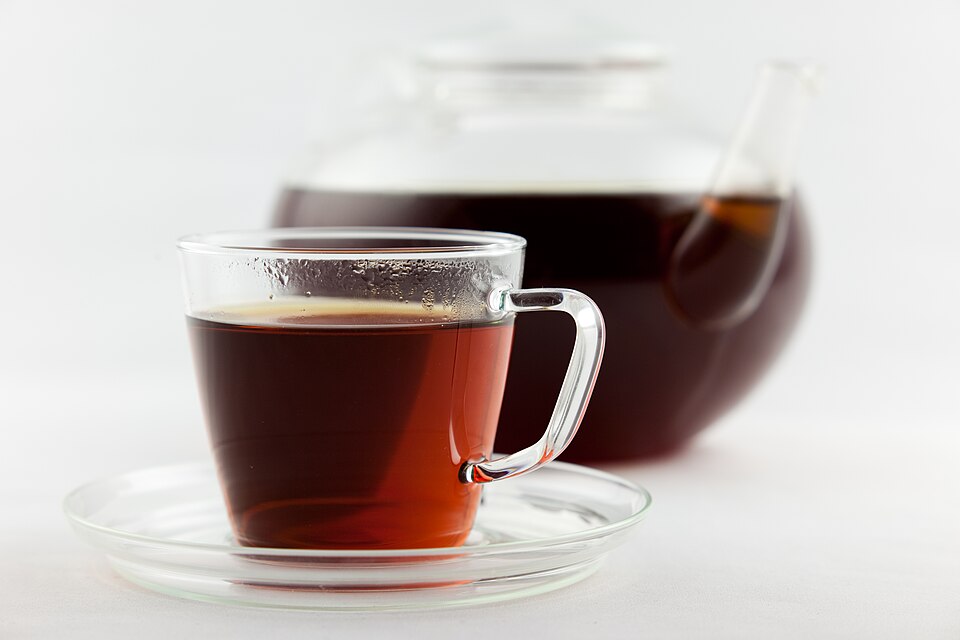
Photograph: soultea.de/André Helbig, CC BY-SA 3.0, via Wikimedia Commons