
Journal ·
Rosemary Leaf
Rosemary is the herb of remembrance. The European monograph for rosemary leaf lists indigestion and bath water, and says nothing about memory at all.
Remembrance Is Not On The List
Season 1 · Episode 10
Ophelia says it in the fourth act of Hamlet, and it's probably the most quoted line anyone has written about a plant.
"There's rosemary, that's for remembrance. Pray you, love, remember."
Four centuries later the European Medicines Agency assessed rosemary leaf and published what it's traditionally used for. The list has two things on it. Symptomatic relief of dyspepsia and mild spasms of the gut, taken as a herbal tea. Relief of minor muscular and joint pain, and minor circulatory trouble in the extremities, used as a bath additive.
Memory isn't on the list. Neither is cognition, or concentration, or anything next door to them.
The single most famous thing about this plant does not appear on its monograph.
What that list is, and what it isn't
It's worth being precise about what the EMA was doing, because the agency is unusually blunt about it.
"Traditional medicinal use means that the use in the specified indication is exclusively based upon long-standing medicinal use and not based on results from clinical studies."
So the two indications aren't trial results either. They're long use, assessed and recorded as long use. The agency adds that while there's insufficient evidence from clinical trials, the effectiveness is plausible and the preparations have been used safely for at least thirty years.
That's a careful, honest document. And memory still didn't make it.
The memory research exists, and it's about smelling
There is real experimental work here, and it deserves to be described accurately rather than waved at.
Mark Moss and Lorraine Oliver at Northumbria University published a study in 2012 in Therapeutic Advances in Psychopharmacology. Twenty healthy volunteers sat in a cubicle with varying levels of rosemary essential oil in the air. Blood samples measured how much 1,8-cineole, one of rosemary's aroma compounds, had been absorbed. Plasma concentration of 1,8-cineole correlated with performance on speed and accuracy tasks.
Five things about that, and all five matter.
The sample was twenty people. The design was correlational, which the authors say plainly; they set out to investigate a possible relationship, not to demonstrate a cause. The exposure was the smell of concentrated essential oil in an enclosed room, not a cup of tea. The proposed mechanism, that 1,8-cineole inhibits the enzymes which break down acetylcholine, is a proposal; the researchers themselves note the blood level might simply be a marker for other compounds present at lower concentrations.
And the fifth is the one that never gets repeated. The mood result went the wrong way. Higher blood 1,8-cineole correlated with lower contentment. The oil didn't improve attention or alertness either.
I went looking for a large independent replication and didn't find one. The finding rests on small studies from a single group. Anyone selling you rosemary for your memory should be asked for the replication before anything else.
Sea-dew
The name is a description of how the plant looks.
Rosemary comes from the Latin ros marinus, sea-dew, for a grey, glistening shrub that grows along the coast. Elizabeth Kent put it well in Flora Domestica in 1823: the botanical name is compounded of two Latin words signifying sea-dew, "and indeed rosemary thrives best by the sea."
It's not quite as classical as it sounds. Virgil mentions rosemary in the Georgics as pasture for bees, but he uses only ros, not rosmarinus. The earliest surviving use of the full Latin word is in Columella.
It changed its name in 2017
For 264 years rosemary was Rosmarinus officinalis, named by Linnaeus in 1753. It's now Salvia rosmarinus, and it's a sage.
The reason is a real problem rather than a fashion. In 2017 Drew and colleagues published a paper in Taxon with the excellent title "Salvia united: The greatest good for the greatest number." Salvia as defined at the time was paraphyletic, meaning it left out lineages descended from the same common ancestor. Rosemary sat in one of the excluded branches. Folding the smaller satellite genera in was what made the group coherent.
The new name wasn't invented for the occasion. Fridolin Spenner had already published the combination Salvia rosmarinus in 1835. The obvious epithet, officinalis, was unavailable because common sage got there first.
Older books aren't wrong. Rosmarinus officinalis was the correct name for over 160 years, and it still resolves as a synonym. Unlike chamomile, there's no second species hiding behind the confusion. There's one rosemary.
How it reached England, by hand
Rosemary is native to the Mediterranean, and to Portugal and northwestern Spain. It was naturalised in China by 220 CE.
Britain took longer and the record is patchy. The Romans probably brought it during the invasion of 43 CE, but there's nothing usable in the record until the 8th century, in a document later credited to Charlemagne, who ordered rosemary planted in monastic gardens.
Then a date you can hold onto. In 1338, cuttings were sent to Queen Philippa by her mother, Countess Joan of Hainault. They were planted in the garden of the old palace of Westminster. After that, rosemary turns up in nearly every English herbal.
A mother sent her daughter a plant. That's how it got here.
Why it grows on Gallipoli
The funerary custom Shakespeare describes was real. Mourners threw sprigs of rosemary into graves. Friar Laurence tells the Capulet household to stick their rosemary on Juliet's body and bear her to church, "as the custom is."
The modern version has a specific and very concrete origin. Rosemary grows wild on the Gallipoli peninsula, where large numbers of Australian and New Zealand soldiers died in the First World War. That's why sprigs of it are worn on ANZAC Day. The Returned & Services League of Australia says so directly: it's the traditional symbol of remembrance worn on ANZAC Day because it grows wild on the peninsula.
The plant didn't acquire a meaning. It was growing on the ground where the men died, and people picked it.
In the blend
Rosemary leaf is three quarters of one part in sixteen and a half.
It's warming, drying and dispersing, a resinous aromatic that lifts the heavy middle of the formula and keeps the blend from lying flat. Under the Ratio Doctrine it enters at the share that holds the thing in balance. At that proportion it's a flavour and an aroma, and it bears no resemblance to the essential oil in Moss and Oliver's cubicle.
What we're claiming
Nothing, medically. This is history.
What's fair to say is that the remembrance in rosemary has always been something people did rather than something the plant performed. Cuttings carried from a mother to a daughter, sprigs dropped into a grave, a sprig pinned to a coat on the 25th of April.
The one thing rosemary has been shown to preserve is fat. Rosemary extract, mostly carnosic acid and carnosol, is approved as a food preservative in several countries under E number E392.
Further reading
Sources consulted for this article and its episode are listed at the bottom of the page.
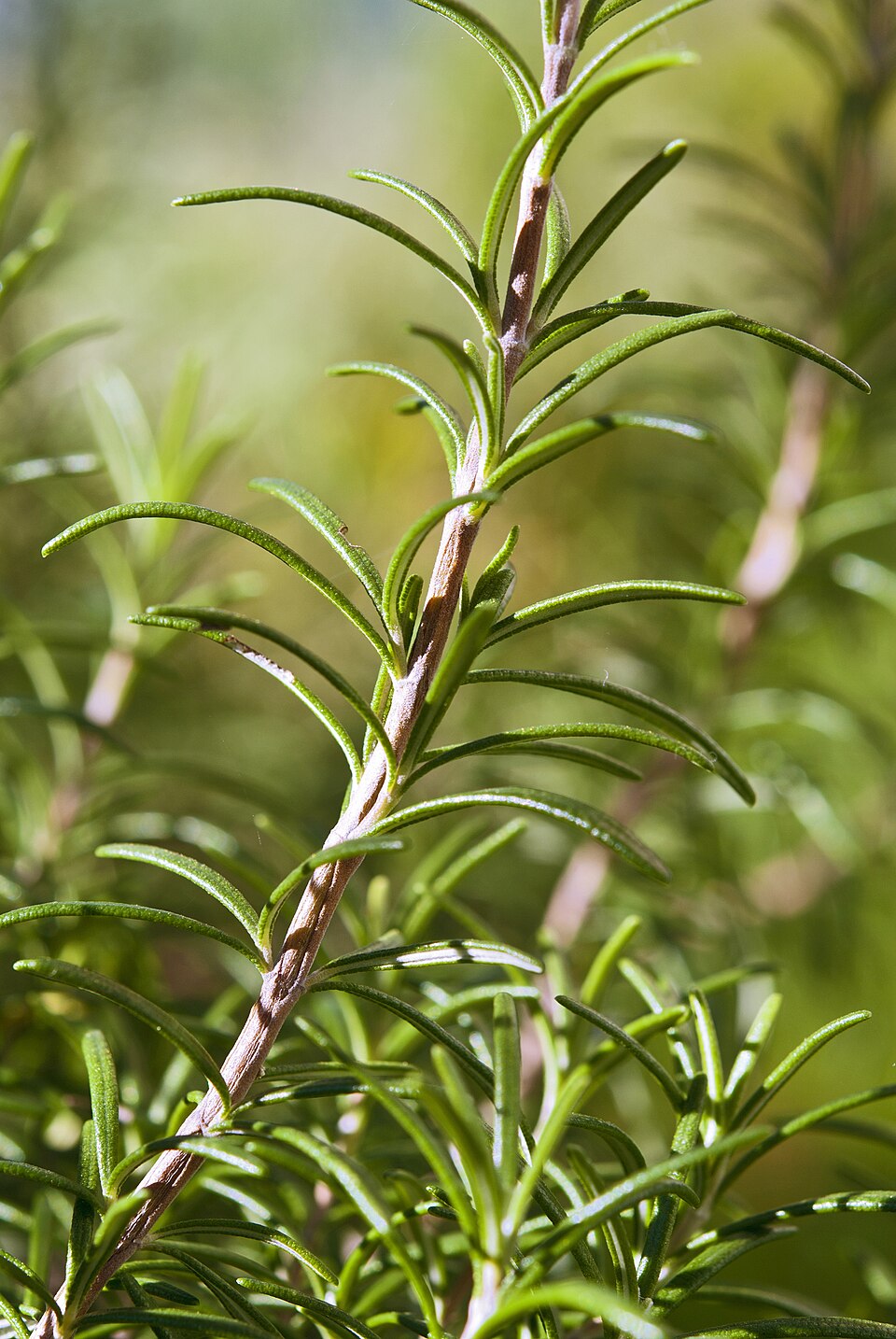
Photograph: T137, CC BY-SA 3.0, via Wikimedia Commons