

Journal ·
The Blend Itself
Every other episode of this show could point at a map. A blend cannot, and what is left when you take the map away is a decision.
The Blend Itself
Season 1 · Episode 15
Every other episode of this show pointed at a map.
Kerala, for the pepper vine. The Cederberg, for the rooibos shrub. A place you could put a finger on, with a soil type and a rainfall figure and an archaeological record underneath it.
Tonight there is no map, because Buckshot & Gunpowder does not grow anywhere. A blend has no native range. Its history is the history of its parts, plus the much shorter history of somebody weighing them out.
And on that second part the record is thin. We could not source a founding date, a first batch, or a naming story, and we are not going to invent one.
That refusal is the episode. What is left when you take away the map and the origin story is a decision, and a decision turns out to be worth more attention than most legends.
A ratio, not a pile
Anyone can put several things in a pot. What makes a formula is that every component is weighed against the whole, and the proportion holds from one batch to the next.
The one share stated numerically in the material we hold is the black peppercorn: three quarters of one part in sixteen and a half. That is small, and it is meant to be. At that share the peppercorn is the heat you notice after you have swallowed rather than while you are drinking, and it sharpens the edges of everything else without announcing itself.
Here is the part that surprises people. Raise that share and you do not get a warmer version of the same cup. You get a different cup, with the heat moved to the front and everything else pushed back. The share is not a dial for intensity. It is what keeps the peppercorn in the role of the back-note at all.
A full parts breakdown for every component could not be sourced. We have the peppercorn share and the structure, and we would rather say so than reconstruct the rest from plausibility.
Two roads, one cup
The vine came from the Malabar Coast of what is now Kerala, and we followed it last episode. Pliny the Elder grumbling that the empire's coin was draining east to India and China. Vasco da Gama reaching Calicut in 1498 with Christians and spices as the stated objective. The Portuguese, then the Dutch, then the British: three empires over one vine.
The shrub came the other way entirely. Aspalathus linearis is a legume, not a tea bush, naturally distributed in the winter rainfall country from about Vanrhynsdorp in the north to the Cape Peninsula and Betty's Bay in the south, on roughly 300 to 350 mm of rain a year. The tea comes from selected forms found mainly on the Cederberg Mountains.
Nothing in either history predicts the other. No trade route connects them, no empire wanted both, and the two plants did not meet until somebody put them on a scale together.
No legend, and why
Myths attach to plants that are found, not to formulas that are decided. Nobody tells a story about a proportion.
So there is no legend here for the blend, and we are not composing one. A fabricated legend is the worst thing a library like this could carry, because it is exactly the sort of thing that gets repeated.
Rooibos's own legend is unusually modern, and it is about ownership rather than wonder. In 1968 Annique Theron is recorded as having found that a rooibos infusion given to her baby relieved the infant of chronic restlessness, vomiting and stomach cramps. She wrote Allergies: an Amazing Discovery on Rooibos in 1970, credited in the source with globalising the tea and bringing it to prominence in America, Europe and Japan. In 1993 she filed a trademark application for Rooibos with the US Patent and Trademark Office and obtained registration in 1994. Rooibos Limited, a South African company, challenged it with the support of the South African government and the Western Cape Province, on the grounds that exporting under the name rooibos would be curtailed in the US if the term were not classified as generic.
We are reporting what the source asserts. We hold no document that settles the outcomes, and we are not adjudicating them.
The mechanism belongs to the smallest component
Piperine is what makes pepper hot, and it has one genuinely interesting modern property.
Piperine changes how the body handles other substances. It can increase the bioavailability of co-administered drugs, and where the therapeutic window is narrow that is a real hazard rather than a benefit.
Read that carefully, because it is a mechanism and not an outcome. Piperine raises the effective exposure to whatever is taken alongside it, and the research behind that concerns defined extracts at defined doses. Turmeric trials add piperine precisely because curcumin is so poorly absorbed without it.
A standardised piperine extract in a capsule is not this blend. The dose, the preparation and the intent are all different, and the evidence does not walk across that gap just because the compound has the same name. Anyone on medication where the dose is finely judged should raise concentrated piperine supplements with a clinician. Pepper on food is food.
Rooibos is described in the source material as caffeine-free, low in tannins and rich in anti-oxidants. Those are compositional facts about a leaf, not effects of drinking it.
The red is made, not grown
The colour that gives rooibos its name is manufactured in the yard, not in the field.
Cuttings are chopped very fine and then bruised, to start the chemical reaction that develops the characteristic colour and flavour. After watering and airing, the tea is left to sweat in heaps, and it is there that it acquires its reddish brown colour and its sweet flavour. Then it is spread out in a large drying yard to dry in the sun, and sorted and graded by length, colour and flavour.
The timeline behind that is slow. It takes 12 to 18 months before a shrub is ready, after which it is cut once a year from December through April for up to five years, and then pulled out and replaced. Only the young branches come off; the old ones stay, and the bushes get slightly taller every year.
Then the blending, which is the shortest and least romantic stage. Weigh and mix in small batches, because a proportion you can check is one you can repeat.
The old virtues, bounded
The oldest layer belongs to the Khoi and San of the Cederberg country. The source material traces rooibos use to their knowledge, as a source of food and medicine, predating the arrival of Jan van Riebeeck at the Cape of Good Hope.
That source does not enumerate which complaints, so neither will we. Folk tradition held it as food and as medicine; which conditions, in what preparations, is not in the record we hold.
The harder refusal is about the blend. There is no established pattern for it as a formula, no sourced traditional indication for Piper nigrum in the material we have, and no controlled trial of rooibos infusion that we could source. Without those there is nothing a formula could be built toward, and what remains is a pleasant cup of tea and a story. That is a perfectly good thing to have.
What we're claiming
Nothing, medically.
What is fair to say is that this cup holds two unrelated facts. A vine that was money for three empires, where a sack of dried berries was a way of holding wealth because it was compact, durable, universally wanted, and could not be manufactured in Europe at any price. And a shrub that was somebody's country before it was anybody's trademark.
Neither fact changes the flavour. Both change what the cup is.
In the blend
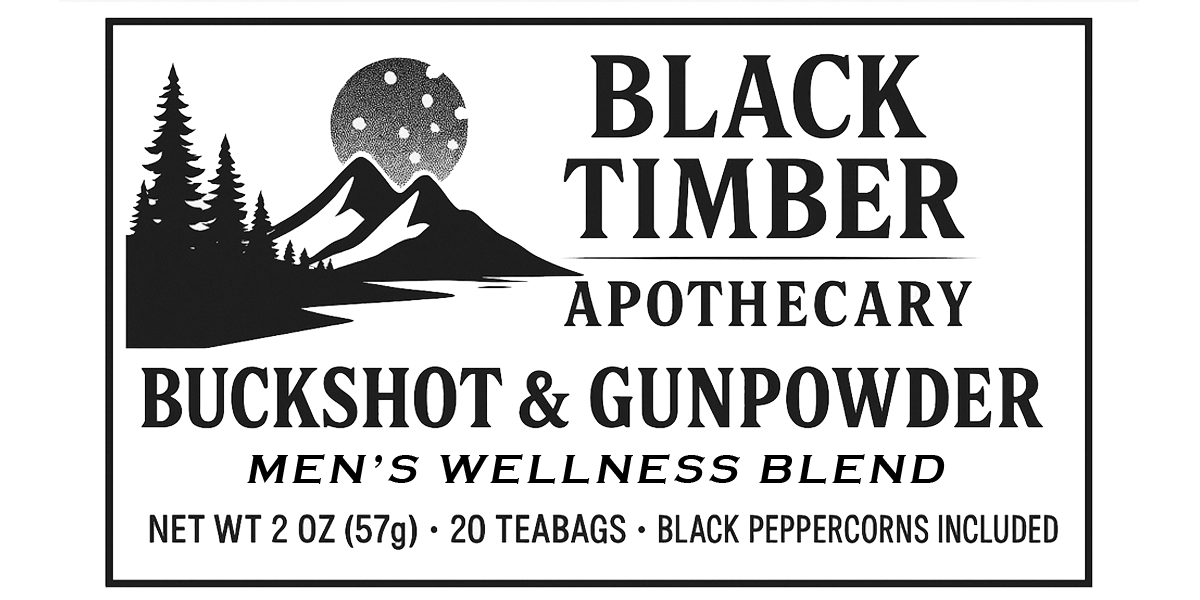
Black peppercorn is three quarters of one part in sixteen and a half, the heat at the back, over a naturally sweet rooibos base. The sweetness is the structural reason the two belong together: a caffeine-free base with that much sweetness can carry a small quantity of peppercorn without the cup turning into a pepper drink.
To brew it: boil, pour over the leaf, cover. Covering matters more than people expect, because the aromatic fraction is volatile and an open cup loses the top notes to the room.
We hold no sourced time or temperature for this blend, only the direction. Hotter water and a longer steep pull the back-notes forward; cooler and shorter keeps the cup in the top notes. The target is balance, and balance is reached before the extremes rather than at them.
Further reading
Sources consulted for this article and its episode are listed at the bottom of the page.