

Journal ·
Turmeric Root
Turmeric is among the most researched plants on earth. In 2017 a mainstream medicinal chemistry journal called its famous compound an unstable, reactive, non-bioavailable compound and a highly improbable lead.
A Highly Improbable Lead
Season 1 · Episode 11
Turmeric is one of the most researched plants on earth. Thousands of papers, decades of work, an entire shelf of supplements built on one yellow compound.
In 2017, Kathryn Nelson and colleagues published a survey of that literature in the Journal of Medicinal Chemistry, one of the field's mainstream journals. Their conclusion about curcumin was that it is "an unstable, reactive, non-bioavailable compound and, therefore, a highly improbable lead."
That is not a blog post. It's medicinal chemists writing in their own journal about the molecule the whole edifice rests on.
Why so much research produced so little
The criticism has a specific technical shape, and it's worth understanding because it explains the volume of the literature rather than dismissing it.
Curcumin is a PAINS compound. The acronym stands for pan-assay interference compounds, and it names a class of molecules that light up across many unrelated laboratory assays. They appear to do something in almost every test they're put through. The reason isn't specific biological activity. It's reactivity and physical behaviour: the molecule interferes with the assay itself.
Curcumin appears on the PAINS lists published by Baell and Holloway in 2010, in the same journal.
So a compound that seems to hit every target is not a compound with many effects. It's a compound that's hard to measure. That distinction accounts for a great deal of the turmeric shelf.
None of that means every turmeric study is worthless. It means the burden of proof is high and a large part of the published literature doesn't meet it.
The gap that governs everything
Before any of the evidence, one number.
Dried turmeric rhizome is roughly two to five percent curcuminoids by weight. Curcumin is one of several curcuminoids in that fraction.
A typical trial uses five hundred to two thousand milligrams of concentrated curcumin extract a day. Frequently with piperine, the black pepper extract, added to improve absorption. Often in a formulated product designed specifically to raise bioavailability, because plain curcumin barely gets into the blood at all.
A cup of tea from a blend delivers a fraction of a fraction. The rhizome is a small part of the blend, the curcuminoids are a few percent of the rhizome, and only some of that extracts into hot water.
The preparation in the study and the preparation in the cup aren't the same preparation. That's the whole of it, and it's the sentence most turmeric writing leaves out.
The absorption problem, and the pepper
Curcumin's poor oral bioavailability isn't seriously disputed. Taken by mouth it's poorly absorbed, rapidly metabolised in the gut wall and liver, and eliminated quickly.
This is why the pepper is there. Shoba and colleagues published the human work in Planta Medica in 1998, showing that piperine co-administration increases curcumin bioavailability.
Worth being careful about what that study was. It used a defined extract with a defined dose of piperine. It's not a finding about grinding black pepper into your cup, and the internet has spent twenty years treating it as one.
What is actually supported
The World Health Organization monograph on Rhizoma Curcumae Longae separates its claims by evidence, which is the useful thing about it.
Supported by clinical data: acid, flatulent or atonic dyspepsia. The monograph cites clinical studies including Thamlikitkul and colleagues, 1989, a randomised double-blind study in the Journal of the Medical Association of Thailand. That study used a defined powdered rhizome preparation, not a tea.
Listed under pharmacopoeial and traditional uses: peptic ulcer, citing a preliminary report of ten case studies from 1986. Ten cases, and the monograph calls it preliminary.
Listed as folk medicine, not supported by experimental or clinical data: asthma, boils, bruises, coughs, dizziness, epilepsy, haemorrhages, insect bites, jaundice, ringworm, urinary calculi and slow lactation. Those are recorded uses. They're what people did, not what was demonstrated.
It isn't a root
Same correction as ginger, and for the same reason.
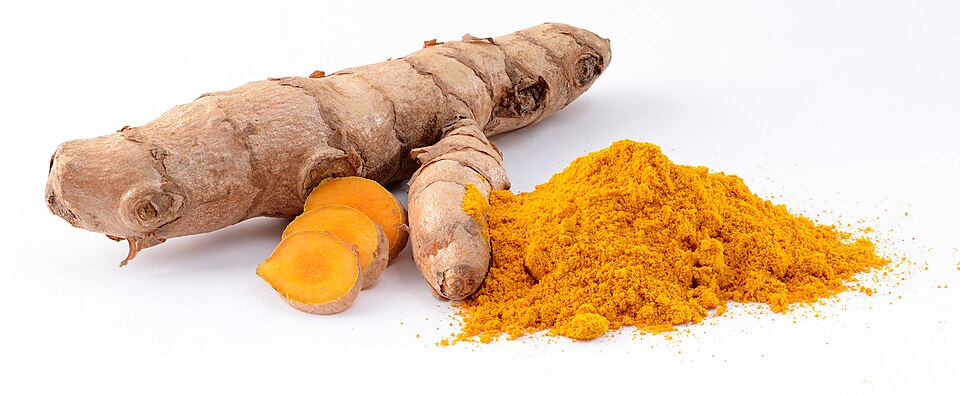
Curcuma longa is in the Zingiberaceae, the ginger family, and the part we use is a rhizome, an underground stem. "Turmeric root" is the trade name and it's what the herbals say, so it's what we call it. The botany is a rhizome.
There's a stranger fact underneath that. Turmeric has no confirmed wild population. It's a cultigen, propagated from rhizome divisions rather than seed, in human hands so long that nobody can point to what it came from.
Merited earth
The English word arrives through Old French from the Latin terra merita, merited earth, applied to the yellow rhizome. The genus name comes from the Arabic kurkum, related to the Sanskrit kuṅkuma. The older South Asian name is haridrā.
In European trade it was the cheap yellow. Saffron was the expensive one, which is how turmeric picked up the name Indian saffron. The name is commercial, and the two plants aren't related.
One claim we're not making: turmeric as an ancient Egyptian dye. It circulates widely. We went looking for a source tying Curcuma longa to Egyptian practice and didn't find one, so we're leaving it alone.
The dye that runs, and the paper that works
Curcumin changes colour with pH. Yellow in acid, red-brown in alkali. That property was put to work in the nineteenth century as curcuma paper, filter paper soaked in turmeric extract and dried, used as a rough indicator for alkalinity and for boron. It was a standard laboratory reagent before universal indicator paper existed.
The same chemistry makes it a poor cloth dye. Curcumin is fugitive to light and degrades under ultraviolet, so dyed fabric fades in sunlight, sometimes within weeks. It went into food, where fading doesn't matter, and only marginally into permanent textile work.
The adulteration is real
Turmeric is among the most commonly adulterated spices, and not always with harmless filler. Lead chromate has been used to brighten the colour of ground turmeric. Lead chromate is toxic, and this is a documented public-health problem rather than folklore, recorded in South Asia and in imported spice supplies.
We're not going to put a number on it. We couldn't reach a specific peer-reviewed paper to anchor case counts or measured lead levels, and inventing one would be worse than saying so.
In the blend
Turmeric is three quarters of one part in sixteen and a half. It gives colour, a mild earthy base and a faint bitterness. It's a supporting component.
It's in at a small share for the same reason chamomile is: the reputation arrives before the plant does, and the blend doesn't need it to carry that.
What we're claiming
Nothing, medically. This is history.
The honest summary is that turmeric is an excellent spice, a genuine dye, a working pH indicator, and the subject of a research literature its own field has called improbable. A cup of our tea is a cup of tea.
Further reading
Sources consulted for this article and its episode are listed at the bottom of the page.
Photograph: Simon A. Eugster, CC BY-SA 3.0, via Wikimedia Commons