
Journal ·
Witches' Brew
The most famous brew in the English language was never meant to be drunk, and the thing people actually prepared was not a drink at all.
The Brew That Was Never Drunk
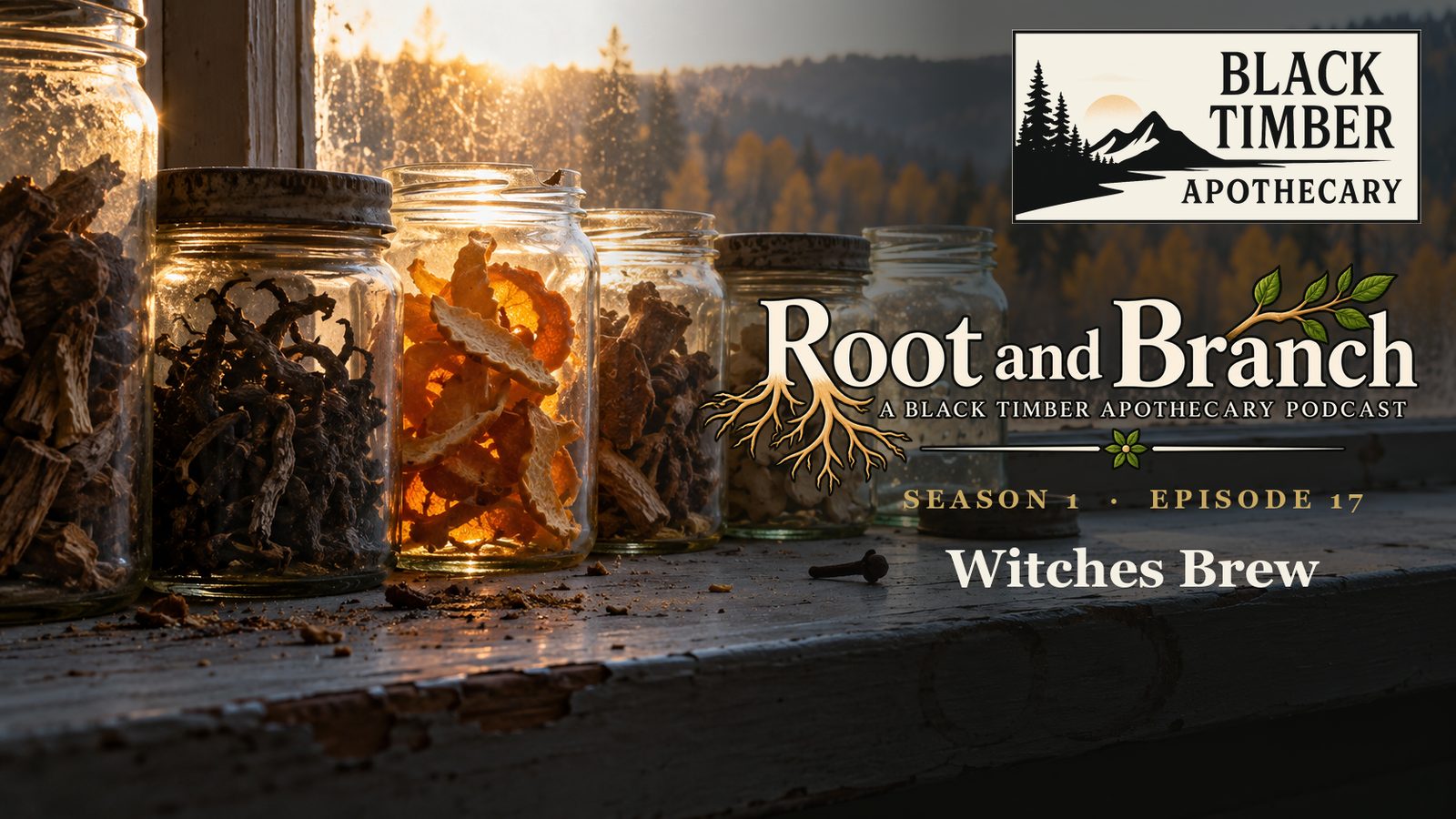
Season 1 · Episode 17
Everyone can picture it. Three figures, a cauldron, something bubbling, something going in that shouldn't.
Two things are wrong with the picture, and they are wrong in the same direction.
The cauldron scene is a stage property, written for an audience that wanted to be frightened. And the preparation that actually turns up in the early modern record, the thing people were accused of making, was not a drink. It was a salve, a fat-based ointment rubbed into skin.
No cup. No cauldron. The word "brew" in "witches' brew" is doing narrative work, not historical work.
This episode is about a drink that does not exist, and about the real plants that got blamed for it.
No plant carries this name
There is no witches' brew species. The phrase names a folklore object, and the plants hung on it are a small set that gets recited as though it were one thing: Atropa belladonna, deadly nightshade. Hyoscyamus niger, henbane. Datura stramonium, jimsonweed or thornapple. Mandragora officinarum, mandrake. Aconitum napellus, monkshood.
That is five genera in three families, with different alkaloids and different margins of danger. A recipe that swaps one for another is not a variation on a theme. It is a different poison.
And one of the five does not belong in the story at all. Datura stramonium is a New World plant. It enters the European repertoire after contact, so billing it as a medieval European ingredient is an anachronism, repeated so often that it now reads as tradition.
The cauldron is older than the witch
Before the witch got hold of it, the cauldron was a good thing.
It appears in Irish and Welsh myth as a vessel of plenty, rebirth and poetic inspiration: the cauldron of the Dagda, the cauldron of Ceridwen. It appears in Norse material as a brewing vessel in the hands of gods and giants. None of these is a witches' brew in the modern sense.
The witch figure was attached to the pot later. It is an overlay, not an inheritance, and once you know that, the modern image stops looking ancient and starts looking assembled.
The compound phrase itself is in print in English by the nineteenth century, meaning a medley, a confused mixture. A dated first attestation with a title could not be sourced for this episode, so none is given here. But the figurative sense is better attested than any literal recipe, which is a clue about what the phrase was always for.
Two items on the list are real
Macbeth, Act IV scene i, written around 1606. Eye of newt, toe of frog, wool of bat, tongue of dog, adder's fork, lizard's leg, howlet's wing.
Chosen for menace and rhyme. The blind-worm of that scene is the slow-worm, Anguis fragilis, a legless lizard rather than a snake, which tells you how much herpetology was involved.
Two entries, though, are not invention.
Witches' mummy is real materia medica. Bituminous matter taken from embalmed bodies, traded in European pharmacies into the seventeenth century and listed in pharmacopoeias of the period. A playwright reaching for the grotesque reached into an actual apothecary's shelf.
Slips of yew is Taxus baccata. Every part except the fleshy red aril is cardiotoxic, and the agent is the alkaloid taxine. The stage prop had teeth.
Deliriant, not psychedelic
Four of the five plants share a chemistry, and it is worth saying what it does rather than what it feels like.
Tropane alkaloids, principally atropine, hyoscyamine and scopolamine, act on muscarinic acetylcholine receptors. The anticholinergic picture is well described in the clinical literature: dry mouth, flushing, dilated pupils, rapid heart, urinary retention, agitation, delirium, seizures.
Note the word. These are deliriants, not psychedelics. Delirium is a confusional state. Disorientation, agitation, and a real risk of injury from not knowing where you are. Popular retellings lose that distinction constantly, and it is the whole difference between the folklore and the emergency department.
Aconitum is worse and different. Aconitine acts on voltage-gated sodium channels, onset is often within minutes, and the classic presentation is numbness around the mouth and in the limbs followed by ventricular arrhythmia. No case-fatality figure could be sourced for this episode, so none is stated.
A mechanism is not an outcome. "It binds this receptor" is a description of chemistry, not a prediction about a person.
The form is the evidence
Here is the detail that settles the argument, and it is a detail about pharmacy rather than folklore.
Johann Weyer's De Praestigiis Daemonum of 1563 and Reginald Scot's Discoverie of Witchcraft of 1584 both describe a fat-based salve. A verbatim recipe from either could not be sourced for this episode, so nothing from them is quoted here.
Why fat? Because tropane alkaloids are lipophilic. They partition into a fatty base, and a fat vehicle both slows absorption and extends it. And the application sites named in the records, armpits, groin, temples, the handle of a broom, are thin-skinned, high-perfusion, or pressed against thin skin for a long time.
The route is consistent with the chemistry. That consistency is why the ointment reading has held up while the cauldron reading has not.
There is exactly one brew in this story with a defensible claim to the word. Henbane seed has a genuine history as an adjunct in European beer before hops displaced it. Small amounts. The practice was abandoned, and the reason it was abandoned is the reason no ratio appears here.
Say which layer is speaking
Three bodies of evidence get mashed into one, and most of the confusion lives in the seam.
The trial depositions are a legal artifact. Confessions were taken under duress, and ingredient lists attributed to accused people were frequently composed by their accusers. The document records what a court found plausible, not what a hearth produced.
The stage play is theatre, fixed in the popular imagination more firmly than any transcript.
The modern reclamation, in contemporary pagan and folk-herbal practice, is a living thing on its own terms, not a survival of the trials.
One more caution. The ointment accounts repeat across sources that copy one another, and repetition across dependent sources is not independent corroboration. The flight-by-absorption reading, associated with Carlo Ginzburg, is a widely repeated interpretation rather than an established mechanism, and the primary pharmacological literature for it could not be sourced here.
Folk tradition held. Researchers have studied. Those are different sentences.
A cup declares nothing
An extract declares its alkaloid content as a number, assayed, with a tolerance.
A cup declares nothing. The alkaloid load of dried plant material moves with species, cultivar, plant part, harvest month, soil, drying temperature and whoever is doing the steeping, and two handfuls of the same species can differ by an order of magnitude. There is no home method for measuring it.
That is not a difference of degree between a strong thing and a weak thing. It is a measured thing and an unmeasured thing, and treating a traditional preparation as a mild version of a standardised one is the error that puts people in hospital.
And for all the recitation, no documented ingested recipe naming a species could be sourced for this episode at all. That is a statement about the search, not a proof about the world. But it is where the trail stops.
In the blend
Not one of tonight's plants is in Buckshot & Gunpowder. Not belladonna, not henbane, not datura, not mandrake, not monkshood.
What's in it is kitchen botany: sixteen and a half parts of it, hand-blended in small batches by a family in the Bozeman valley, Montana, with black peppercorn's three quarters of one part putting the heat at the back.
If you want something for the season that actually belongs in a cup, the honest shape is a bitter base from roasted chicory or dandelion root, the weed we gave a whole episode to earlier this season, with a little dried orange peel and a single clove. Warming, aromatic, faintly bitter. The story lives in the presentation, not in the chemistry.
What we're claiming
Nothing medical. This is history, and the history is better than the legend.
The most famous brew in English was never drunk. The thing people actually made was rubbed on. The cauldron was borrowed from gods and giants who used it for poetry and plenty. The phrase, in print, means a muddle.
Which is the truest thing about it. The honest core of "witches' brew" is a confused mixture, and people have been brewing that ever since.
Further reading
Sources consulted for this article and its episode are listed at the bottom of the page.