Journal ·
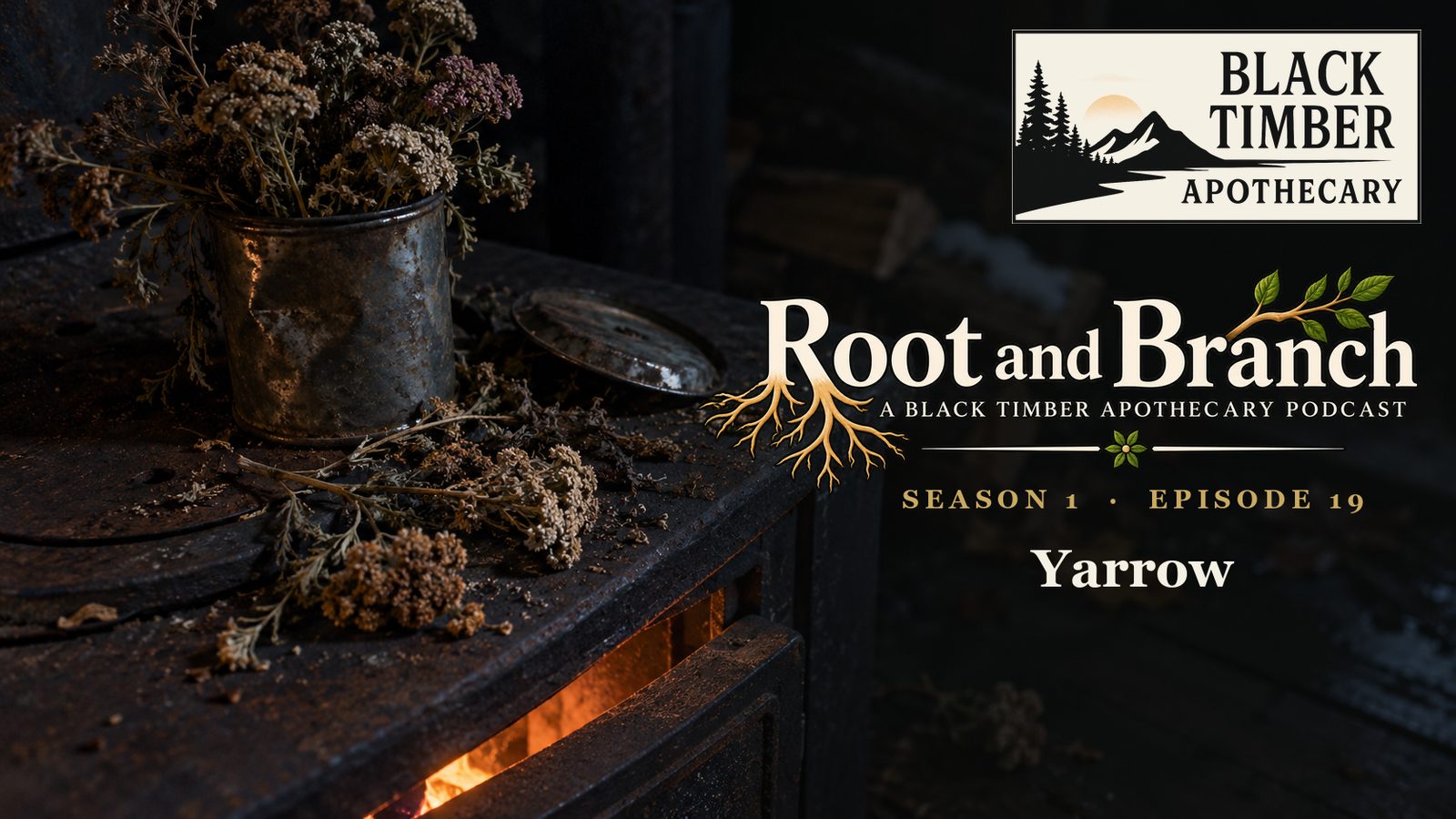
Yarrow
The genus Achillea is named for Achilles, and the Iliad never says the plant's name. Yarrow's reputation is older than any evidence for it.
The Herb Homer Never Named
Season 1 · Episode 19
There is a plant in the roadside ditch that carries the name of a Homeric hero.
Achillea, for Achilles. The one Greek the whole tradition agrees was the best of them, and his name is on a flat white weed that grows in gravel and gets mown by the county twice a summer.
The story attached to the name is that Achilles carried this plant to staunch the wounds of his men, and that Homer tells us so.
Homer does not. The poem never says the word.
A hero's name, attached afterwards
Linnaeus gave the genus its binomial in Species Plantarum in 1753, and the Achilles association was already old and already repeated by then. The attribution is real as a naming tradition. What it is not is a quotation.
Book 11 of the Iliad has Patroclus tending a wounded Eurypylus, and a bitter root is pressed into the wound. The poem does not identify the plant. Naming it yarrow is a later interpretive act, made by classical and medieval commentators and hardened by repetition into something that reads like epic text.
We went looking for a classical passage that names yarrow as Achilles' herb and could not source one. It circulates in modern herbals without a locatable primary citation, so it stays here as tradition and not as fact. The further version, that his soldiers carried the plant to Troy, we could not source to any ancient writer at all.
The name is older than its evidence. That is the whole episode in one line.
"Yarrow" is not one plant
Achillea millefolium is in the Asteraceae: a rhizomatous perennial, twenty to eighty centimetres in most forms, finely dissected feathery leaves, flat-topped corymbs of small white to pinkish florets, flowering roughly June to September. The epithet means thousand-leaf, for the foliage.
Now the complication. What European and North American writers have called yarrow for centuries is not a species in the tidy sense. It is a polyploid complex, with cytotypes running from diploid through octoploid, overlapping in appearance and differing in volatile oil chemistry. Regional floras split it into related taxa depending on the authority followed.
So a seventeenth-century English herbal, a Chinese divination record and an ethnographer's field note may not be describing the same biological thing. We will say so each time it matters.
Sneezewort, Achillea ptarmica, is a different plant with its own history, and it does not stand in. The English word itself descends from Old English gearwe.
The paper trail is long and the species is not pinned
Dioscorides, in De Materia Medica in the first century CE, describes a plant he calls stratiotes, soldier's herb, and muriophyllon, used for wounds and for stopping bleeding. Pliny's Naturalis Historia carries similar uses. Whether either writer's plant is A. millefolium or a Mediterranean relative is not settled, and we could not source a determination to species.
From there it runs forward: the Anglo-Saxon Lacnunga and its nine-herb charm, the Grete Herball, William Turner's herbals, and Nicholas Culpeper's English Physitian, which assigns yarrow to Venus and reasons from the divided leaf. Sources differ on Culpeper's year of publication, so we are not giving one.
Two divinations, and they are not one story
In Britain, a sprig of yarrow went under the pillow with a spoken rhyme, so that a young woman would dream of a future husband. The verse varies by region, and we could not source any version to a named collector or a dated printed collection. So there is no rhyme quoted here. Inventing one would have been easy and would have been a lie.
In China, the stalk method of consulting the I Ching uses fifty dried stalks, one set aside, of the plant the texts call shi.
Here is the turn. That plant is an Achillea in Chinese tradition, and it is almost certainly not A. millefolium, which is not native to China. Sources name A. sibirica or A. asiatica, and they differ. Anyone writing that yarrow is the I Ching plant has flattened two unrelated practices that happen to share a genus.
The blue measures the still, not the stand
Yarrow essential oil is famously, beautifully blue. The plant is not.
The colour is chamazulene, and chamazulene is an artefact of distillation. Matricin and related proazulenes present in the plant dehydrate under heat to produce it. The blue therefore reports precursor content and distillation conditions. It is a record of what happened in the still, and buyers pay for it as though it were a measure of the stand.
The sesquiterpene lactones in that same fraction carry the anti-inflammatory reasoning, in vitro and in animals, and they are also the family's chief sensitiser. The same compounds do both.
We could not source a single-agent trial of the infusion for any clinical endpoint. A mechanism is not an outcome, and a concentrated extract at a declared marker content is not a covered cup of tea. The findings do not walk across that gap in either direction.
Where the cup is actually decided
Timing and temperature, not the recipe.
Cut flowering tops at full bloom, in dry weather, once the dew has lifted, taking ten to twenty centimetres of stem. Dry in shade or low forced air at 35 to 40 °C, thin bed, turned once. Hotter strips the monoterpenes and the herb smells of nothing in particular. Slower moulds it and you get hay.
The dried herb keeps the bitter and loses the top notes, which is worth knowing: the cup is not the one the fresh plant would have given. Store whole, never powdered.
Infusion only, and covered, because the volatile fraction is the point. One to two grams in 150 to 250 mL at 95 to 100 °C, five to ten minutes. Boiling drives off the aromatics and pulls harsh tannins instead.
Long use, thin evidence, real cautions
Keep the traditions separate. The European wound and bitter-tonic line, the Chinese shi of divination, and the North American Achillea records, which rarely resolve to a species, are three records and not one.
Germany's Commission E approved yarrow for appetite loss and dyspeptic complaints. The European Medicines Agency monograph covers the flower's traditional use. Those are the named documents.
The caution that matters most is the family. Yarrow is Asteraceae, and its sesquiterpene lactones are recognised contact sensitisers that cross-react with ragweed and with the chamomile from Episode 9. Anyone with that sensitivity should be careful handling the fresh plant. Pregnancy caution rests on yarrow's traditional emmenagogue reputation; we could not source a study demonstrating harm, and we are stating it as the tradition it is.
Nosebleed and soldier's woundwort are the same plant
The folk record has yarrow stopping a nosebleed. Elsewhere, the folk record has it provoking one, deliberately. Both names survive: nosebleed and soldier's woundwort, one plant.
The tradition kept both without embarrassment, and no account reconciling them could be sourced. The point is that a name records a practice, not a property. People did two opposite things with the same leaf and named it after both.
Today it is a roadside weed, a line item in a wildflower seed mix, a stop on a foraging walk. The hero's herb moved out of the medicine chest and into the meadow.
In the blend
Yarrow is a small supporting share of the sixteen and a half in Buckshot & Gunpowder, never the lead. We are not putting a number on the share.
What it does is the dry edge at the back of the cup: bitter, faintly camphoraceous, a little floral. At a supporting share it holds the blend from going soft. Given the lead it would bully everything else, which is a thing worth saying about most bitter aromatics.
What we're claiming
Nothing medically. This is a name and a paper trail.
What is fair to say is that a genus carries the name of Achilles on the authority of a poem that never mentions the plant, that its most famous colour is made by the still rather than grown, and that the same species was called both nosebleed and woundwort by people who meant it literally in both directions.
Further reading
Sources consulted for this article and its episode are listed at the bottom of the page.